
How it all began
During her years as a student at an inclusive school, Charlotte Henning completed a practicum at Alanus University and expressed an interest in an inclusive social volunteer year there. Unfortunately, this program – which we also saw as an additional year of inclusive education for people with disabilities – was discontinued at Alanus University.
Then, while visiting an education fair in her town, Charlotte learned about the College for Social Education in Mannheim. In her uniquely charming and disarming way, she asked whether it might be possible for her to continue her inclusive education there, to work toward her dream of becoming teaching staff in the primary labor market.
Then, something almost unbelievable happened: As a result of her inquiry, the entire faculty decided that they would like to make their school more inclusive. They established an additional course of study, ‹Social Education Assistance› in the summer of 2024. This program offers low-threshold access to training as educational staff. High school graduates with a qualifying diploma can train to work as ‹Social Education Assistants› in an educational setting. After successfully completing this three-year training program, graduates can enroll in a teacher training program at the same college (in Germany, the Abitur – the qualifying diploma for university admission – is typically required for this). In order to accept Charlotte, a young woman with trisomy 21, the school requested permission from the relevant Ministry of Education. This permission was granted. However, no funding was provided, with the result that all systemic changes and supportive measures to date have been carried out through a high level of additional engagement on the part of the college professors, the teachers at the municipal kindergarten, and, above all, Charlotte herself.
We will set aside the political twists and turns for now, but Charlotte was indeed the first young woman with a diagnosed special educational need named «intellectual and developmental disability» to be accepted at a German college for social education.
The faculty agreed, and the class for the ‹Social Education Assistance› training program ended up being much larger than expected: 24 young people from the widest variety of countries, with widely varying school experiences and language skills, set out to attend (and help shape) this training.
The training program is fundamentally practice-oriented: The students spend three days a week in a kindergarten, for which they are paid by the program. This lightens the kindergarten teachers’ workload without the financial burden of hiring extra help. The other two days of the week, the students attend classes at the college.
Charlotte was able to help out part-time at a kindergarten in her town. Last year, she worked two half days a week with one of the kindergarten groups, and attended two full days of classes per week with all of the other students in her program. On Wednesdays, some of the Alanus University students organized a study and review course with Charlotte. On these days, she participated in artistic courses (eurythmy and music) with the second-year students in the Curative Education Bachelor’s program, and the students helped her prepare and review the content of her college classes.
One student decided right away, in the fall of 2024, to write an evaluation of the first few months of this inclusive training program for her bachelor’s thesis.
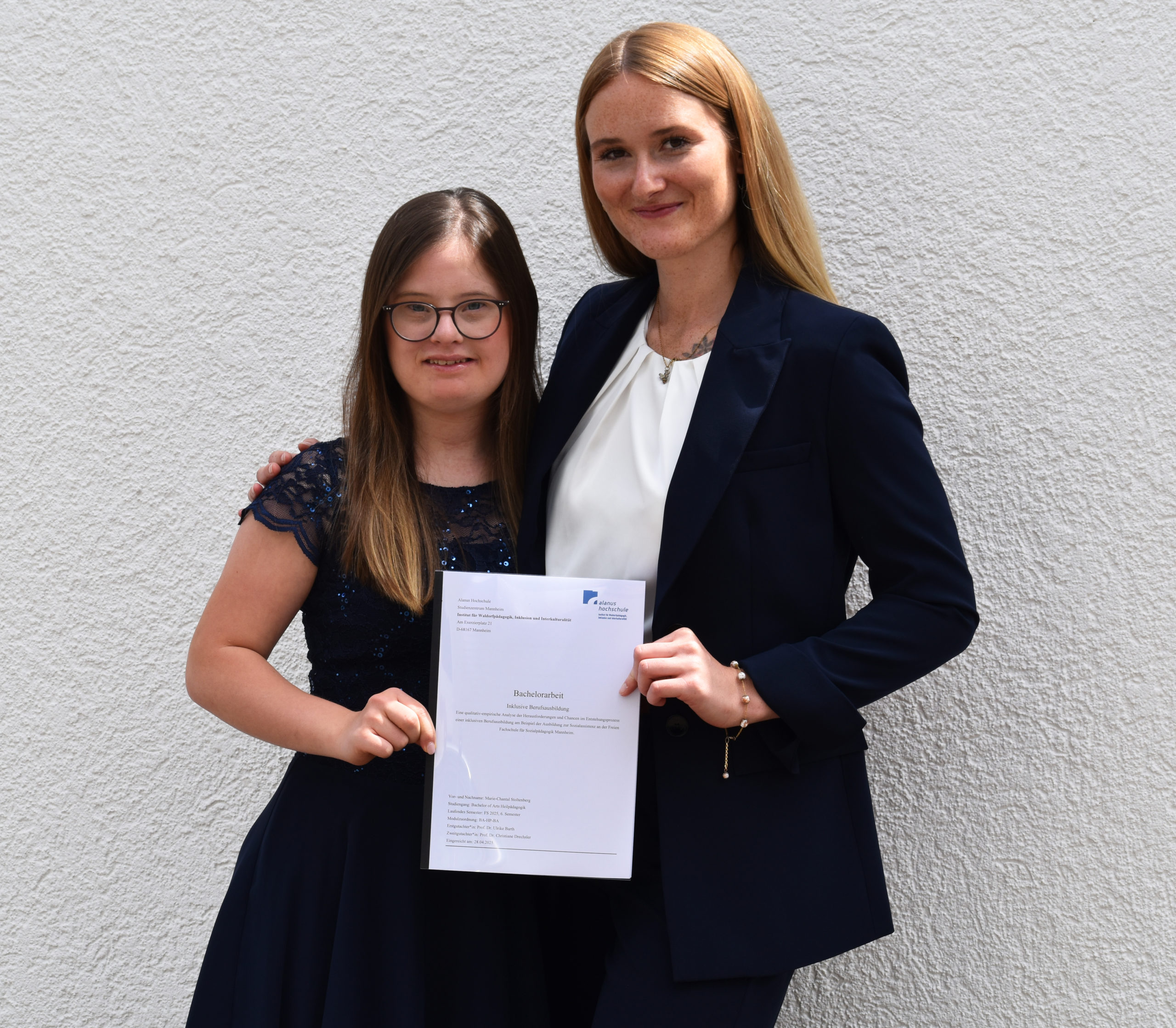
Charlotte Henning (left) and Marie-Chantal Stoltenberg (right) with diploma, Photo: private
Approach
The research process resulted in a series of inquiries into the educators’ previous experiences, their fears and wishes before the start of the course, and the challenges they actually faced, as well as reflections on the coping strategies and wishes that emerged during the first few months of the program.
The college's teaching staff and the kindergarten's practicum supervisors addressed questions about their fears and wishes regarding the new training model. To this end, the director of the training program, the teaching staff at the college, and the practicum supervisors at the kindergarten were given semi-structured interviews before the project began. These interviews were available for use in the bachelor’s thesis, and provided the impetus to conduct another survey of these individuals after the first few months of Charlotte's training, and to participate as an observer in the various learning contexts. Charlotte’s participation in the college courses and her work in the kindergarten were documented at monthly intervals using the phenomenological research methodology, perceptual vignettes, developed by Barth & Wiehl (2023). Several study and review sessions were also evaluated.
An unbiased and open attitude toward what the research process reveals is an important prerequisite for gaining broad insight – a decisive reason why, in addition to interviews, the research methodology of perceptual vignettes was used. These vignettes made it possible to capture small micro-sequences that might have gone unnoticed in everyday life but were of great significance in the reflection phase.
Perceptual vignette example from January 16th, 2025:
«Ms. Frank and Charlotte are making a circle of chairs. Paul is new to the kindergarten group and is standing in the middle of the circle, looking around. All of the other children are waiting by the door with Ms. Seidel. ‹Come, Paul, I have a job for you,› says Charlotte, and takes his hand. Charlotte leads Paul to a chair. ‹Take this chair and put it in the circle,› says Charlotte to Paul. Paul picks up the chair and puts it in the circle. Then he goes and picks up another chair to put in the circle.»
During the visits, a large number of perceptual vignettes were recorded, each highlighting different areas of focus. For example, they illuminated subtle instances where inclusion appeared, and others that revealed the challenges of choosing teaching methods in class. In the evaluation process, it was important to identify the different dimensions: Was it about the interactions between the college students, the interactions between teachers and students, Charlotte's interactions with the kindergarten children, or Charlotte's interaction with the other students in the study and review sessions? The following thematic groupings emerged across all of these dimensions: integration or inclusion; attention; collaboration in the college; and closeness and distance as a general theme with classmates and with the kindergarten children. A large number of perceptual vignettes had to be recorded in these dimensions and groupings to evaluate them.
After this intermediate step, the respective areas of focus that emerged from the perceptual vignettes were addressed through the three levels of reflection (Barth & Wiehl, 2023). Beginning with individual reflection, the areas of focus highlighted by the perceptual vignettes became apparent. The second level of reflection requires a scholarly examination using specialist literature. Different reflection texts were identified for the different dimensions and groups. In this way, ‹interaction› can be examined using texts on discrimination (e.g., ableism), topics such as ‹inclusion and participation› can be explored in more detail using the questions from the Index for Inclusion, and ‹didactic challenges› that became apparent in the classroom had to find a reflective equivalent in relevant specialist texts. Developmental process-oriented reflection based on the Compensation Age Theory developed by Hefziba Lifshitz (2020) was particularly striking and important for the further course of the project.
At the third level of reflection, a discussion arose about the program development that had taken place within the overall process. At this level, the perceptions of the teaching staff (both college and kindergarten) were incorporated through additional semi-structured interviews in January 2025. It became clear that the teaching staff had been self-reflecting in real time as their wishes and fears materialized, forcing them to confront them and create new ways of doing things.
Experiences
This new teaching format presented teaching staff with new challenges and tasks, not only in terms of methodology, but also in their facilitation of social interactions. Apprehension about interacting with someone with trisomy 21 initially led to distancing within the training course, but with time transformed into respectful exchanges, considerate interaction, and a genuine interest in fellow human beings outside the students’ closest circles of friends.
Charlotte’s fellow students described this course as their favorite because of their experience that everyone was able to be themselves and accepted just as they were, with the recognition that everyone has a unique life story.
Results
The wish for good community spirit and balanced interaction between the students, as well as the need to enable Charlotte’s understanding and the resulting necessary changes in methodology, required both creative thinking and experimentation on the part of the teaching staff and active involvement on the part of the students. In particular, avoiding separate arrangements in day-to-day activities offered students an opportunity to interact with each other and ensured Charlotte's participation.
Simple language, supplementary visuals to accompany texts, and clear structures enabled Charlotte to manage her school or workday independently and to actively participate in class or at work.
Concrete tasks at the kindergarten, such as reading the children a story or offering an artistic project, as well as taking part in daily classroom chores, allowed Charlotte to immerse herself in the role of a ‹social education assistant.› At the same time, she demonstrated her ability to join the children in their play, and was happily accepted by the children.
The perceptual vignettes from the kindergarten clearly show the development of Charlotte’s initiative and self-confidence, as well as her ability to adapt her actions to a given situation and respond to the children’s needs, even when these needs were not verbalized. The practicum supervisors realized the importance of addressing Charlotte directly in a given situation and of focusing on clear and constructive communication.
It was interesting to observe the non-judgmental and open interactions between Charlotte and the children. Charlotte's trisomy 21 did not seem to be a major factor in their daily activities and interactions. Instead, the children responded to what Charlotte offered them: She is a playmate or an assistant and guide for specific activities.
The teachers (at both the college and the kindergarten) recognized the importance of regular interdisciplinary consultation and coordination of their teaching methods. The need for further research into teaching methods became obvious, to enable teachers at the college to offer a wider variety of teaching styles and, above all, to make classes as understandable as possible for all students while meeting the necessary requirements.
Looking ahead
While the development-process-oriented reflections in the perceptual vignettes consistently revealed a high degree of amazement and a revision of the beliefs and attitudes of those involved, a workshop for the college class held as a part of the program at the end of the first year of observation was recognized as a milestone:
«‹What does inclusion mean to you?› A young woman who had immigrated from Uganda volunteers: ‹Inclusion is totally normal for us. Where I come from… In our schools, it is totally normal to be together. If there is a person who needs help, maybe because of a handicap, there is always help from somebody. We are used to helping if we see that someone needs help. It does not matter if this is during the lessons or during the meals – everyone has to look [out] for everyone. Maybe because there is no assistance at all. I don’t know if maybe you mean this by inclusion?›»
The college had instituted a buddy system for Charlotte in order to help her integrate better with her classmates during breaks. In this workshop, we became aware of a broader potential: Almost all students have experiences of exclusion or discrimination. For many of the immigrant students, for example, targeted support tools (texts in simple/easier language, visual media, etc.) can be a great help. We implemented inclusion as an immersive educational tool in Charlotte’s case, but the fact that it could be helpful to each and every student was one of the most important insights of this first year. We had suspected as much, but it became very clear during the workshop.
In the coming school/academic year, two master’s theses will focus on creating teaching and learning materials for the context of inclusive education, and one will explicitly examine both the potential and the challenges in municipal kindergartens as a starting point for possible longer-term development.
Ultimately, the goal is to support a widely known hypothesis: Inclusion benefits not only people with trisomy 21 – it benefits everyone.
Translated by Tascha Babitch.
Literature:
Barth, U. & Wiehl, A. (2023). Wahrnehmungsvignetten. Phänomenologisch-reflexives Denken und professionelle Haltung. Klinkhardt.
Booth, T. & Ainscow, M. (2019). Index für Inklusion. Ein Leitfaden für Schulentwicklung. Beltz.
Lifshitz, H. (2020). Growth and Development in Adulthood among Persons with Intellectual Disability. New Frontiers in Theory, Research, and Intervention. Springer.