

Author: Gabriele Scholtes, with contributions by Ferdinand Klein
Publisher: Verlag am Goetheanum and Athena/wbv (2025)
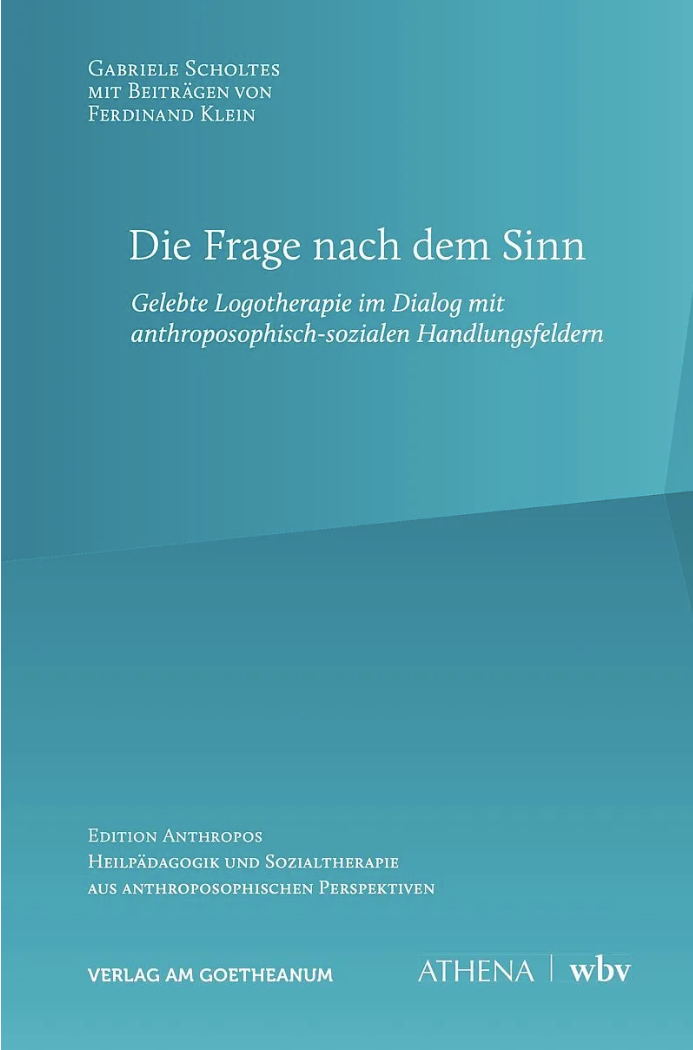
In her new book, Gabriele Scholtes offers a praiseworthy attempt at relating the work of the Viennese psychiatrist and neurologist Viktor E. Frankl to fields of anthroposophical social activity. Frankl spent his life exploring the question of the meaning of human biography, establishing the third school of Viennese psychotherapy. His concept clearly distinguished him from Sigmund Freud and Alfred Adler, the two other protagonists of the Viennese schools. Frankl was concerned with the search for meaning, which in his view is «given to every human being—regardless of intelligence, level of education, gender, or age» (p. 9). This premise also reflects the basic idea of anthroposophical social therapy.
In her book, Scholtes succeeds in showing how Frankl’s logotherapy and existential analysis are related to the approach of anthroposophical social therapy and how they can be a support and complement in practice.
In the first chapter, Scholtes discusses Frankl’s eventful biography: born in 1905 to a Jewish family in Vienna, he enjoyed a happy childhood and then pursued studies in medicine. Already at a young age, he was made director of a clinic. When the National Socialists took power, he chose not to emigrate to the United States out of consideration for his parents; he allowed his visa to expire and was therefore forced to endure four different concentration camps in the years that followed. He survived the hardships and privations but lost several people close to him. That is why «logotherapy and existential analysis are not abstract concepts, but rather a fusion of theoretical thought and existential experience. Frankl himself suffered existentially through his idealistic concept, and his insights are closely interwoven with his own embodied existence» (p. 11). Frankl received great respect in his lifetime and died in Vienna in 1997; his life’s journey, after travels in many different countries, had come full circle.
In the second chapter, Scholtes presents the fundamentals of logotherapy and existential analysis. She focuses in particular on the anthropological foundations, the concept of meaning, and the categories of values.
In chapter three, she connects Frankl’s approach with the anthropological foundations of anthroposophical social therapy using various concrete everyday issues to illustrate not only similarities but also mutually enriching impulses provided by the two approaches.
This is followed by two articles by Ferdinand Klein, educational scientist and logotherapist, the first dealing with practical logotherapy and curative education, the second with the fundamentals of meaning-oriented education. Klein broadens the perspective, incorporating ideas from Martin Buber, Aaron Antonowsky, and Janusz Korczak.
The book concludes with reflections on ‹Growing old: Becoming a journeyman of the unknown› and ‹Meaning and conflict: Self-help in conflicts›, with the second contribution strongly oriented toward the approach of conflict researcher and organizational consultant Friedrich Glasl.
Throughout the publication, the author succeeds in demonstrating how anthropological approaches founded at the same time or later in related disciplines can enrich the practical effectiveness of anthroposophical curative education and social therapy and expand its scope of activity. Self-reflection is encouraged, and discovering the richness and depth in Frankl’s work can be an inspiring experience for the reader. His unconditional recognition of the meaningfulness of every life, his categories of values, and his linking of freedom and responsibility offer important points of reference when dealing with professional issues for anyone seeking guidance in the field of accompanying people in need of assistance. Like Steiner in his Curative Education Course, Frankl attaches great importance to humor in the supportive accompaniment of individuals. For Frankl, humor is an important basis of logotherapy and the «immediate, genuine, and most original attribute of being human» (p. 18).
This book, with its various contributions on logotherapy and existential analysis by Viktor E. Frankl, is interesting and worth reading. It can broaden and deepen our own horizons for new perspectives on professional tasks. Unfortunately, the first part of the book contains a few repetitions that could have been avoided with more careful editing. Though this hardly detracts from the overall impression, and despite this minor criticism, we hope that the book will be widely read and attract an interested readership.
Translated by Joshua Kelberman.
