
Camphill Korea began its journey in 2009, not as a Camphill village but as a Waldorf school. Over time, it grew into a living community where today around thirty people – including adults with support needs and co‑workers – share daily life together. To an outside observer, it may appear as just one more Camphill community among many around the world. Yet what gives Camphill Korea its unique character is not only Rudolf Steiner’s vision, but also the cultural ground in which it has taken root.
Korea has long carried a deep communal spirit. This spirit is not an abstract philosophy, but a lived heritage shaped by generations of shared life. Community here is not merely something we construct; it is something we remember and embody. The story of Camphill Korea is therefore not only about the import of a European idea, but about a meeting point: the ideals of freedom, equality, and fraternity woven together with the Korean memory of shared responsibility, harmony, and interdependence.
Roots of Community in East Asia
To understand Camphill Korea, we must first understand how the very notion of community is already embedded in East Asian thought. In Confucian philosophy, the human being is not seen as an isolated self, but as a node in a network of relationships. Life begins not with autonomy but with ren (benevolence) and li (ritual conduct).
These words may sound abstract, but they describe something deeply practical. Ren is the quality of caring for others as part of oneself. Li is the shared rhythm of life – greetings, gestures, customs – that holds relationships together. In Korean society this has produced a worldview in which identity is always relational: ‹I› is never simply ‹I›, but always ‹I in relation to you.›
This means that social responsibility is not something added later, but something felt from the beginning. A child learns respect by how they bow to elders. Families eat from shared dishes rather than separate plates. Even language reflects this: Korean grammar itself changes depending on the relationship between speaker and listener. Such practices form a cultural DNA that make communal life feel natural, even inevitable.
While Western individualism often asks, «Who am I?», the Confucian orientation begins with, «With whom am I?». It fosters cooperation, empathy, and shared responsibility – fertile ground for a life together, and for the spirit of Camphill. At the same time, it can create its own tensions: the tendency to avoid disagreement, to prioritize harmony even when an individual voice needs to be heard.
A Monistic Vision of Life
Beyond Confucianism, East Asian thought often perceives reality itself as a single, interconnected whole. Daoist and Buddhist traditions both speak of the unity of life: nothing exists apart from the whole.
Daoist texts often use images from nature. «Heaven and I were born together; all things and I are one,» wrote the philosopher Zhuangzi. To a Western reader, this may sound poetic, but in the Daoist world it is not metaphor but truth. Just as a river flows around a rock without breaking, life is understood as moving with the current of the world, not against it. Freedom, here, is the ability to align with this flow rather than to dominate it.
In Buddhism, the same intuition is expressed through the principle of dependent origination: all beings arise only through relationship. A tree cannot exist without soil, water, and light; a person cannot exist apart from community, history, and environment. Nothing is self-contained; everything is interwoven.
This worldview shapes Korean culture in subtle ways. Trust can be assumed, not negotiated. Coordination happens without constant debate. People can act ‹in rhythm›, intuitively sensing what the group requires. It is this sensibility that makes Camphill’s vision of wholeness and interdependence feel so resonant in the Korean setting.
Historical Practices of Communal Life
The philosophical roots of community were always accompanied by concrete practices in Korea’s villages. Long before modern institutions, people relied on deeply cooperative traditions that shaped everyday life.
One example is hyangyak, a kind of local covenant created during the Confucian era. Beginning in the 15th century, village scholars drew up codes of conduct that guided everyday life for more than five centuries. These agreements included caring for the poor, resolving disputes fairly, and ensuring respect for elders. In effect, they became a form of communal self-governance, sustained by trust and moral obligation rather than external law.
Another example is gye, a rotating credit association that functioned as an informal bank. Early forms existed over a thousand years ago, and by the Joseon dynasty they had become widespread among farmers and merchants. Neighbors contributed small amounts of money at regular intervals, and in turn each person received a larger sum when it was their turn. Beyond finances, gye cultivated solidarity: it was a safety net, a way of saying «we rise and fall together.»
Then there was pumasi, the exchange of labor without money. Its roots reach back into Korea’s earliest agrarian societies nearly two millennia ago. When a family needed to plant rice, the whole village came to help, knowing that tomorrow the same hands would be there to build a roof or harvest crops for someone else. These rhythms of reciprocity meant that no one faced hardship alone. Time and energy flowed through the community like a shared currency.
These practices were not marginal experiments, but the fabric of life itself. The fact that hyangyak lasted over 500 years, that gye has existed for more than a millennium, and that pumasi can be traced back almost two thousand years shows just how deeply communal life has been woven into Korean culture. Community here is not a new experiment, but a civilizational inheritance, carried quietly through generations.
The Challenges of Modernity
Of course, no tradition remains untouched. In the last half-century, Korea has undergone one of the fastest transformations in the world: rapid industrialization, relentless urban growth, and the pressures of global capitalism. Communal rhythms that once seemed natural have been strained or erased.
In cities, neighbors live stacked in high-rise apartments, often without knowing one another’s names. Education and employment are pursued with intensity, but often at the cost of shared life. Success is measured by speed, productivity, and competition – leaving little room for the slower work of community.
And yet, the longing for connection has not disappeared. It reemerges in times of national crisis: candlelight vigils that filled the streets in moments of political upheaval, or collective volunteer efforts after natural disasters. In those moments, people rediscover the old truth that life is stronger when lived together.
These contrasts highlight why the work of Camphill Korea is not nostalgic, but timely. Community here is not about recreating a romanticized past, but about reawakening a capacity that modern life has neglected. The question is not whether Koreans can live communally – they have done so for centuries – but whether we can remember how to weave those threads anew in the present.
Camphill as Renewal
In this light, Camphill Korea is not so much an innovation as it is a renewal. Life in the village is built not on efficiency but on relationship. People with support needs and co‑workers share daily tasks, festivals, and decisions. In these rhythms, Steiner’s Three Social Principles come to life: freedom in cultural expression, equality in rights and voice, and fraternity in shared work. None of this is without struggle, but it feels familiar, as if an old memory was being lived again.
What is renewed here is not only a way of organizing daily work, but a long-buried communal memory. Camphill reminds us to ask not only how efficiently we live, but how meaningfully we live together: how dignity is safeguarded by relationships more than by systems, and how belonging arises from recognition rather than provision. Seen in this way, Camphill gestures toward a new imagination of social welfare in Korea – not delivered as a service, but a shared fabric of care in which work, celebration, and responsibility are held in common.
In Korea, this renewal feels less like invention and more like remembering – echoing older rhythms of cooperation and reciprocity that once shaped village life. It reframes support for people with disabilities as a matter of community rather than category, of shared life rather than managed service. What returns is a civic habit of ‹we›, capable of meeting modern isolation without erasing individuality. Camphill thus renews something essential that was present all along, waiting to be lived again.
This renewal does not stand alone. It resonates with a wider movement now unfolding in Korea. In September 2024, the first national assembly of anthroposophy in Korea was held, leading to the founding of the Korean Anthroposophical Society. This marks a turning point: anthroposophy is no longer just a set of scattered initiatives, but a recognized movement with roots in Korean culture. For Camphill Korea, this provides a larger context, connecting its daily practice of community life with a nationwide search for spiritual and social renewal.
The Story of Camphill Korea
The story of Camphill Korea itself reflects this pattern of renewal. Its seed was planted by an art student, Eunyoung Kim, whose volunteer work with young people on the autism spectrum led her to discover Waldorf education and anthroposophy in the 1990s. Captivated by the transformation she witnessed, she left her teaching career at the age of forty to study in Germany, eventually spending a formative period in Newton Dee, one of the Camphill communities in Scotland. There she experienced what she later described as «a life of dignity and joy» – a way of life she felt compelled to bring back to Korea.
Upon her return, she gathered colleagues and parents who shared her vision. In 2009 they opened the Yangpyeong Steiner School, beginning in a rented pension house with a single class. The school quickly grew, becoming both an educational space and the nucleus of a future community. By 2015, faced with the urgent question of how young people with developmental disabilities would live as adults, Kim sold her own home to purchase land in Yangpyeong. With the help of co‑workers, parents, and donors, they built the foundations of what is now Camphill Korea.
The first house, Acorn House, opened in 2018. Its beginning was not a matter of abstract planning but of urgent human need. One young graduate, Seungmin Oh, had long commuted with his mother between Seoul and Yangpyeong. After his mother was injured in a traffic accident, the community realized that waiting any longer was no longer an option. Acorn House began with Seungmin and a young co‑worker, Jaeyong Choi, who had himself discovered Camphill during overseas service. What started with two people soon grew into a shared home of six people with support needs and four co‑workers, supported by the official recognition as a home for shared living.
From there, the community expanded further. In 2021, they opened Nuri, a day program offering bakery, pottery, woodworking, handicrafts, and therapeutic farming. Today, Camphill Korea holds together three pillars: homes for living, workshops for work, and centers for learning. Around twenty community members with support needs and fifteen co‑workers now live and work together, striving to create a place where people with and without disabilities share life without division.
This story of Camphill Korea shows how the impulse of Steiner and König can take root in Korean soil: through sacrifice, through trust, and through the conviction that every person’s time and life is meaningful.
Between Collectivism and Freedom
At the same time, Korea’s collectivist heritage brings its own tensions. Harmony is highly valued, but sometimes at the expense of autonomy. It is easy to confuse peace with silence. For Camphill Korea, this creates a delicate task: to honor the communal spirit while also protecting the unique voice of each individual. This is not a problem to solve once and for all, but a rhythm to practice daily.
This tension reveals the deeper dialogue between Camphill’s spiritual orientation and Korea’s communal philosophy. Rudolf Steiner, in Toward Social Renewal (1919, GA 23), wrote: «The life of the spirit will only flourish when it is independent, when it stands on its own ground of freedom.» For him, every human being is an eternal spirit, and true community must allow each person to unfold this inner freedom. In contrast, Confucian ethics has long emphasized the primacy of relationship. As the Analects remind us, 仁 (Ren) consists in loving others, and harmony is the most valuable function of ritual. In this view, the self is shaped not in isolation, but through duty, respect, and harmony within the group.
At first sight, these seem opposed: one prioritizes freedom, the other collective balance. Yet, when held together, they create a field of possibility. Steiner expressed this paradox in his so-called ‹Motto of the Social Ethic›: «The healthy social life is found when in the mirror of each human soul the whole community finds its reflection, and when in the community the virtue of each one is living.» Camphill Korea becomes precisely such a place – where freedom is not abstract independence, but the courage to bring one’s unique voice into relationship with others. And harmony is no longer passive conformity, but the art of weaving many voices into one song.
This meeting point suggests that the future of community does not lie in choosing between autonomy and solidarity, but in learning their mutual dance. The spiritual depth of anthroposophy and the cultural memory of Korean communal life can, together, offer a vision of community that is both universal and deeply local – rooted in tradition, yet open to transformation.
Living the Social Principles
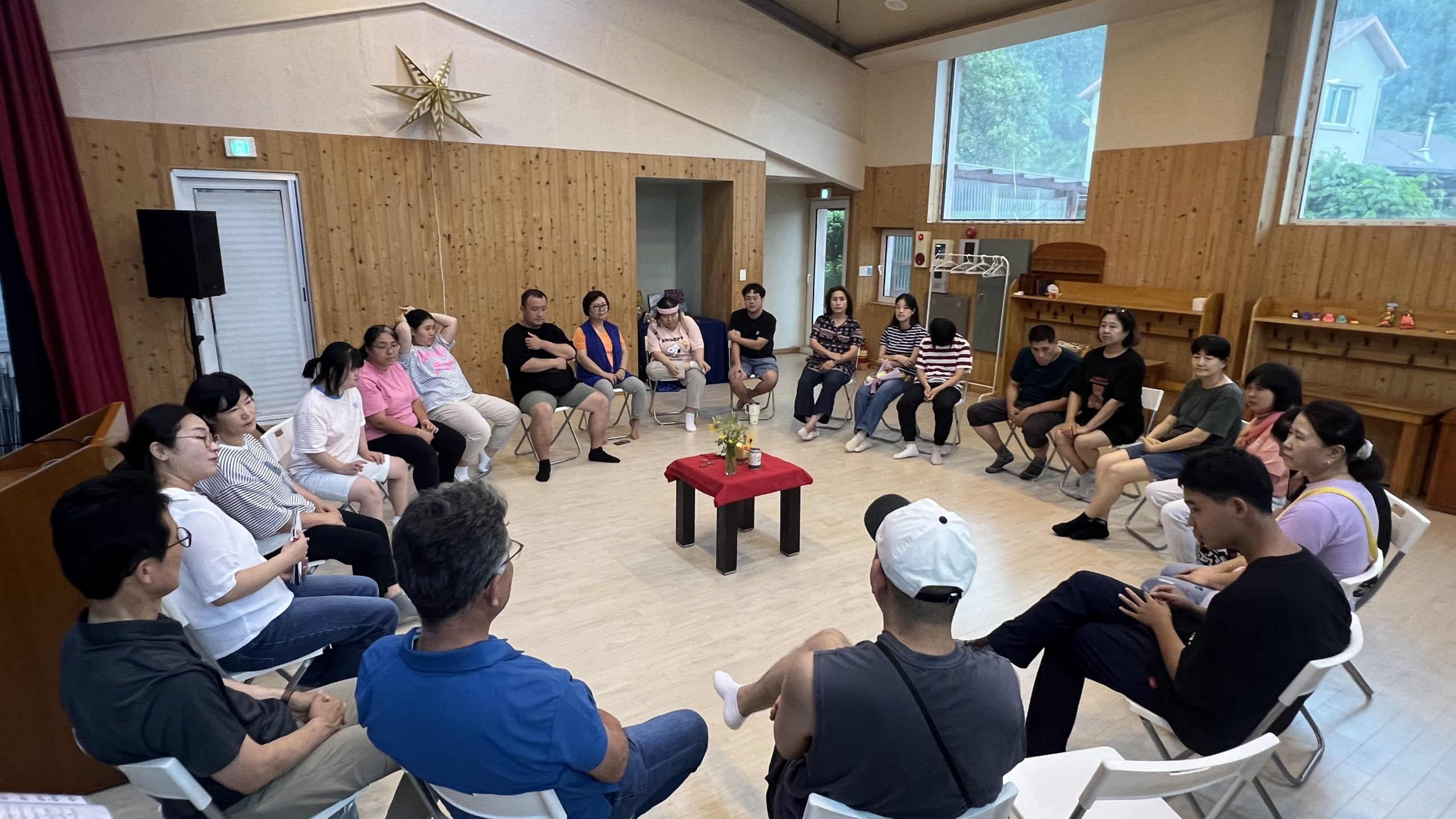
Today, Camphill Korea seeks to embody the Three Social Principles in ways that are true to both Steiner’s vision and Korean culture. In cultural life, festivals and artistic expressions are shared by all. In social life, community meetings ensure that each voice is heard and respected. In economic life, work is distributed by presence rather than productivity, and a common ‹pot› is created where those who have more contribute for the good of all. These efforts are not perfect, but they are lived with sincerity.
Perhaps the deepest expression of this cultural dialogue is found in how we name one another. In Korea, forms of address usually emphasize hierarchy or roles. But in our community, we chose to simply use each other’s names. This simple change affirms that we are not primarily ‹teachers› or ‹patients›, nor ‹service providers› or ‹clients› but persons meeting persons. As a Korean poet once wrote, «When he called my name, he came to me and became a flower.»
This is not just a poetic gesture, but a cultural shift. In calling each other by name, we reclaim the dignity of the person beyond role or label. It is a daily reminder that the foundation of community is not efficiency or conformity, but recognition.
The work of Camphill Korea is still young, and challenges remain. Yet its significance lies precisely here: in showing that even in a fast‑paced, competitive society, it is possible to remember other rhythms. It is possible to build a life where care, equality, and freedom are not ideals on paper, but practices at the table, in the garden, in the meeting circle.
In this way, Camphill Korea is more than a single community in Yangpyeong. It is part of a larger conversation – between East and West, between past and future, between harmony and freedom. Its story suggests that community is not something we must invent anew, but something we must learn again to live.
And at the heart of it all, as simple as a name spoken with care, is the person.
Photo: Camphill Korea