
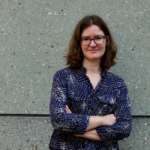
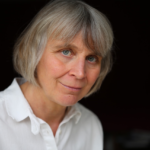
Since ancient times, vulnerability has been seen as human fallibility. In her new book, ‹Offenheit und Berührbarkeit› [‹Openness and The Ability to be Touched› – transl.], currently only available in German, Basel-based philosopher Barbara Schmitz explores the positive aspects of vulnerability as a human condition and universal characteristic.
Stefanie Schälin: Your beloved dog, Paulina, recently passed away. She is also a topic in your new book. To what extent was the death of your dog a moment in which you experienced vulnerability as a concrete part of your humanity?
Barbara Schmitz: That’s a good question. I was very close to Paulina, partly because she had a disability and had lived for many years with only three legs. That may have made my attachment to her especially strong. Her death was a real lesson in vulnerability, and it showed me how every attachment makes us vulnerable. An intense connection with another being, whether animal or human, always comes with the risk of being hurt. We often feel abandoned when that connection is lost. A parting like that leaves behind a void, and a feeling of loneliness. Loneliness is a serious form of vulnerability, and it is troubling that so many people in our society feel lonely. It is the downside of excessive individualism and the extreme pursuit of autonomy. However, we must differentiate between different kinds of aloneness. Not all aloneness is bad, per se. There is also a kind of solitude that is an important refuge.
Loneliness is not the only kind of vulnerability, but it is one of our greatest vulnerabilities because it affects so many areas of our lives. Being in pain, for example, is much worse if we are also lonely.
Learning from people with disabilities
StS How did you come to write a book on vulnerability?
BS Many issues that have preoccupied me in my life, such as disabilities, suicides in my family, and my philosophical reflections on pain, can be summarized very well under the umbrella term ‹vulnerability›. So I have been preoccupied with this topic in its various facets for a long time.
Looking back, it was an experience of great vulnerability when I had Carlotta, who has a disability. I was thirty years old and had all sorts of plans; I still wanted to live abroad for many years, and longed for adventure. Having a child with a disability taught me a lot. As a young woman, it was devastating to endure the pain and fear and to acknowledge how fragile we are and all the things that can happen, until I began to understand how unbelievably lucky I was and what an opportunity it is—what extraordinary richness there is in this unique relationship. It would be wrong to think we could simply demand this of parents. We have to give them time to learn how to handle this experience.
Today, I think I’ve learned a lot about dealing with vulnerability from Carlotta. She has taught me a lot, because she deals with vulnerability so brilliantly. She doesn’t see the fact that she is vulnerable in her unique way as a flaw or a difficulty. For example, she cannot tolerate being spoken to in a harsh, hard tone. She knows this and stands by it. And she tries to explain this to others: «You know, I don’t do so well with that kind of tone.» I think it’s wonderful, the way she has learned to embrace her vulnerability. For her, it’s not an option to say, «I need to learn to deal with this.» Instead, she says, «You know, that’s a tone that’s really hard for me.» In this way, she gives the other person the opportunity to say, «Okay, let’s see how we can do this differently.»
As a child, I was often told that I was too sensitive and needed to develop a thicker skin. I still believe that’s wrong. Carlotta shows us that it’s not about a thicker skin; it’s about how we can communicate better, so that neither of us feels hurt. She’s amazing at that, and it’s really beautiful.
StS You write that we can learn a lot about dealing with vulnerability from people with disabilities. Why?
BS People with disabilities show us that human life is always vulnerable. Many of us like to deny that, because we feel like we’re strong and invulnerable. There have been stories of people who are ‹invincible› since ancient times, but that is the wrong approach. I see examples of how we can deal creatively with vulnerability in Carlotta, who does not see it as a weakness. She says, «Okay, there are some things I can’t do,» and deals with this productively.
In general, people with disabilities show us that we are all interdependent, and that this dependence is not a weakness, but rather something positive. It is important that this care for others is expressed in a positive manner and that consideration is given to what this means for both sides, particularly when power structures are involved. It is also about striving to manage asymmetry in a relationship effectively. It is too readily assumed that two autonomous individuals always engage in a symmetrical exchange. That is not the case.
The myth of an autonomous individual
StS What is problematic about our image of an autonomous individual and the associated idea of invulnerability? This idea is very prevalent in our society.
BS This image goes back to ancient times. For example, Achilles, whose mother dipped him in the river [Styx] so that he would be invincible. Or Siegfried, who bathed in dragon blood. And there are many other myths we have deeply internalized that assume that invulnerability is something to strive for, something heroic. We still have this idea today, if in a slightly changed form. The ideal of the strong individual permeates our culture.
Interestingly, a counter-movement has developed that focuses on vulnerability, but almost uses it as a weapon. For example, managers are told in seminars that it is important to show vulnerability to the workforce in order to build trust or to show that «I am like you.» This is used in part strategically. It is a strange development because it does not really create a connection, but is intended to increase productivity. Perhaps this is a tendency of our time: Since we cannot completely eliminate vulnerability, we try to use it strategically.
StS Is vulnerability becoming commodified?
BS Yes, exactly. Incidentally, the same thing happened with the term ‹resilience.› Originally, it was a term used in materials science to describe the indestructibility of a material or its particularly good resistance. In the 1970s, two psychologists applied resilience to the human context. They found that one-third of all children who grew up in very difficult circumstances on a Hawaiian island, i.e., with poverty, parental drug addiction, low education, etc., had developed well despite these circumstances. They called these children ‹resilient› and looked for factors that explained why these children were able to develop in this way despite adversity.
The term was then also adopted to describe how people deal with strokes of fate, such as death or serious illness. If someone can cope well in these situations, the assumption is that they are resilient.
The term has since been adopted into the realm of work. Businesses now say, «We need resilient employees, who can easily deal with stress and adversity.» In this way, resilience has increasingly become a term for a kind of magic power that is supposed to enable people to both cope with strokes of fate and difficult situations and easily handle adverse working conditions. This is a problematic development, because the term is being appropriated by economics. Resilient individuals keep systems running, even if the systems are unjust. Enormous demands are placed on individuals, with the assumption that they must find the strength within themselves. The fact that people cannot always manage this is ignored. We need to become aware of this and to take it seriously. Human beings are vulnerable. And that means they can also break under terrible circumstances. I believe it is very important to recognize that.
Our first question should be, «How can we help?» We should shift our focus away from the idea of the resilient individual and toward community, in which we help each other.
Resilient societies
StS We have been talking about the individual. But shouldn’t a society be resilient? Especially in terms of what society's role would be if an individual can't cope with circumstances or breaks down as a result of them?
BS You are absolutely right. The idea of resilience makes sense for a society. Ultimately, I think the concept of safety and security [German: ‹Geborgenheit› – transl.] is also important, because it implies that we could have a society in which people could be vulnerable and still feel safe and supported. This is lacking today, because many only think about and take care of themselves. The awareness of being secure, of being supported by others to a certain extent, and of knowing that someone will be there to help if I can't manage on my own is disappearing. This is because our social structures always promote individualism.
StS So the idea of community is of central importance?
BS Absolutely. A state of safety and security isn’t something that I can create myself – we can only create it together. Carlotta has an amazingly good sense of this. She works in a team and is a part of that team. If someone is having a bad day, everybody pitches in and it’s not a problem. She is quite clear on how much we need other people in order to feel safe and for a community to really work.
StS You write that in order to have a strong society, we need vulnerable human beings. Can you say more about that?
BS That’s also connected to safety and security. If we were a society of only ‹strong› people, in the sense of completely autonomous individuals, we would end up with a rather fragmented form of coexistence. That would weaken us, because we can never be invulnerable. For example, it would be an illusion to think I could never become ill. Being mortal is also an expression of vulnerability. People who cannot live up to that ideal of ‹strength› show us how differently life can be lived. They show us how to deal with being dependent on others. Anything can happen to any one of us, but something very positive can grow out of this vulnerability, like creative ideas, closeness, or the ability to be touched. Our skin is the best example of this: It is vulnerable to pressure, impact, and cuts, and at the same time is a source of enormous joy when caressed by a tender touch or a soft breeze. It is an expression of how vulnerability is also the source many positive things. If we all had an armored shell, like Siegfried’s skin, we would miss all of that. We would no longer be human beings.
Openness and the ability to be touched
StS And you did title your book ‹Offenheit und Berührbarkeit› [‹Openness and the Ability to be Touched›].
BS Originally, I wanted to title the book ‹Verletzbarkeiten› [‹Vulnerabilities› – transl.], but the publisher said that title wouldn’t sell, because it’s too negative. This shows a view of vulnerability that judges it to be exclusively negative. In the end, we were able to agree to the current title, which emphasizes the positive sides of vulnerability. We are open to the world and not isolated from it. We depend on touch, though touch can also be violent, which is something that also needs to be addressed. There is vulnerability that arises from circumstances, i.e., power dynamics or systems of oppression. Although vulnerabilities are often positive, such as openness and the ability to be touched, they can also be negative when unfair power structures lead to great vulnerability.
StS Earlier, you spoke about how people with disabilities are good at dealing with vulnerability. At the same time, it is precisely this group of people who are more often exposed to violent power dynamics.
BS Exactly. It is important that we think about questions of power and vulnerability. We cannot avoid power imbalances between people. We are all at the mercy of others, people with disabilities even more so than other people. That’s why it’s important to think about how to deal with this carefully. How can we find a way to live that doesn’t exploit vulnerability or turn it into something negative?
StS We’ve reached the end of our interview. Is there anything important you would still like to emphasize?
BS Vulnerability is something that affects both individuals and society. I think it’s important to always consider these two levels together. It’s a challenge for our individual lives because we have to deal with illness, death, loss, etc. But figuring out how to deal with it is also a societal responsibility. We should create social structures and support communities that enable individuals to live with vulnerabilities. These two levels – individual and societal – are always in interaction. Because there is less and less emphasis on community, dealing with vulnerability is becoming more difficult for individuals. This is also the source of the loneliness we talked about at the beginning.
Incidentally, I will be writing my next book about loneliness.
Translated by Tascha Babitch.
Link: https://www.barbara-schmitz.net/
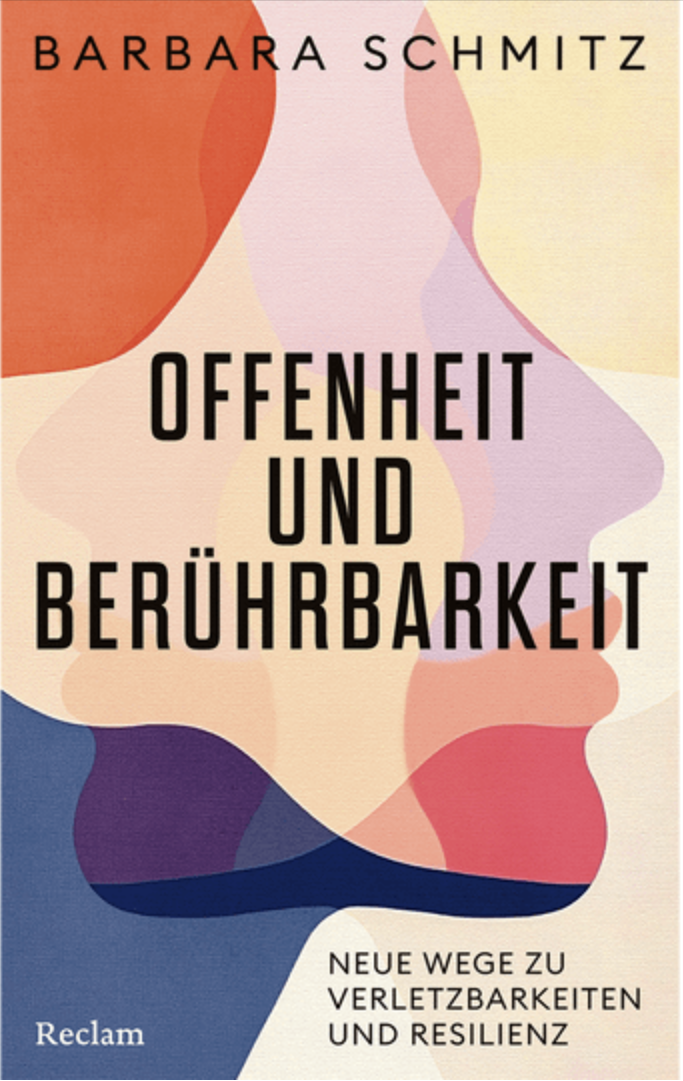
Schmitz, Barbara. Offenheit und Berührbarkeit: Neue Wege zu Verletzbarkeiten und Resilienz. Reclam Verlag, 2025.