

Author: Hartmut Rosa
Publisher: Suhrkamp (2026)
[English forthcoming from Polity Books.]
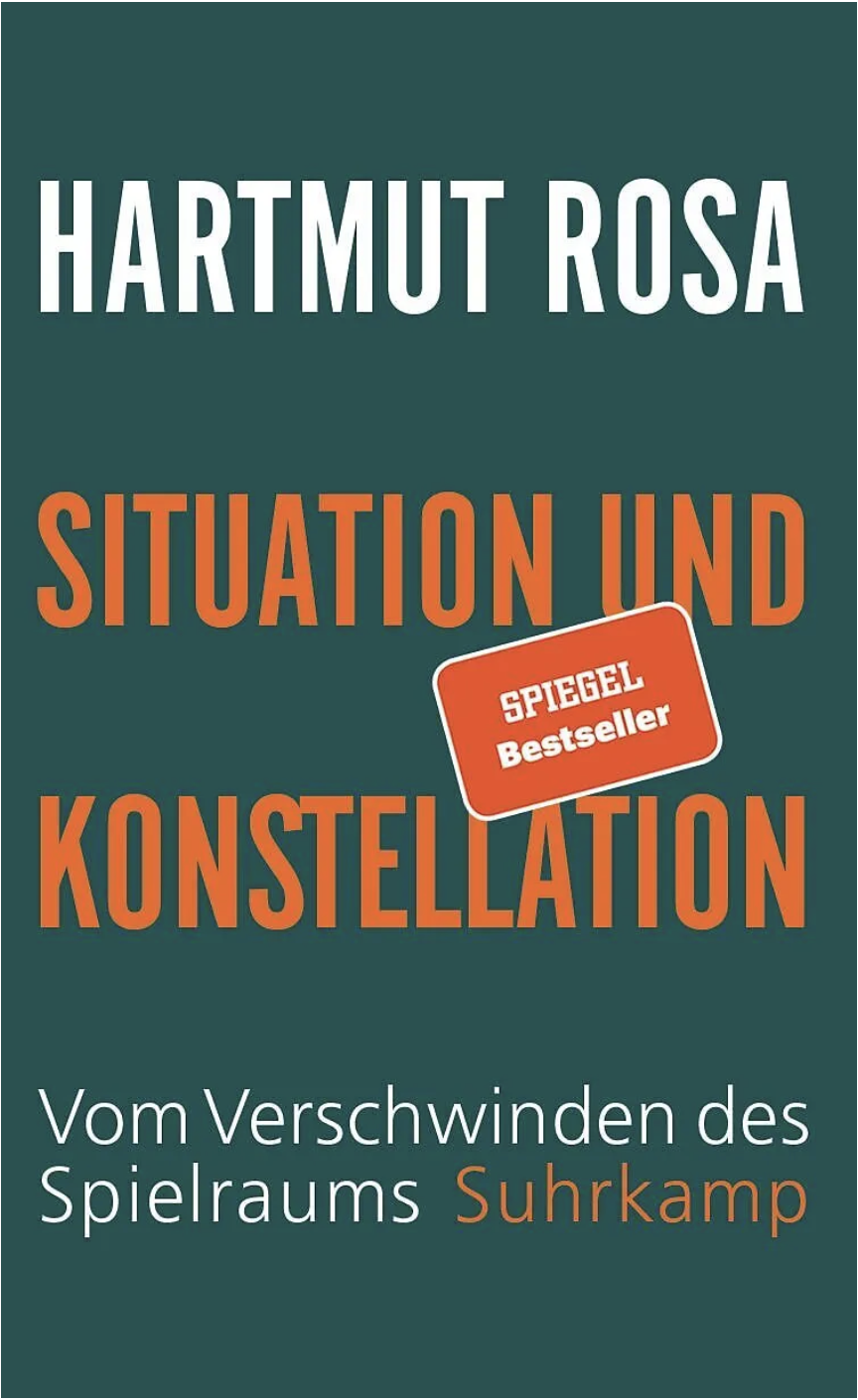
Though only published in March 2026, Hartmut Rosa's recent book (1) has already gained widespread attention. (2) This is probably due to the fact that his insights address our everyday experiences (for example, chapter 2 is titled: «At the doctor, on the train, at school, on the ski lift, and on a moped: Sites of transformation»). With vividly illustrated examples, he describes the modern transition «from acting to executing,» (p. 7) and thus provides a wide range of points of reference that virtually anyone, in almost any context, would reply, «Yes, that's exactly how I experience it too!»
Rosa explains and defines exactly what he means by this transition: «Acting means having room to maneuver within a complex and often ambiguous web of interactions. It requires the exercise of judgment, which, in turn, is based upon experience […].» (p. 11) In contrast, when we merely execute an action, we «follow a protocol or are guided by rules and algorithms that are immune to interpretations based on the situation and moral judgments.» (p. 10)
Instead of retelling the book's narrative and reflections, I'd rather apply its contents to the field of social work. Because, in this field in particular, all of this can be experienced quite intensively—and with especially serious consequences.
Ultimately, the key question involves what is referred to, for example, by the Ways to Quality Foundation [Stiftung Wege zur Qualität] (3) as «relationship-based service»: How can working relationships be structured in which, on the one hand, there is an imbalance of power or ability in favor of the ‹service provider,› while, on the other, the person they are working with—often incorrectly referred to as the ‹service recipient›—must themselves make a contribution, engage in an activity, or undergo a process of development or learning in order for the work to have an effect?
This already describes the dilemma outlined in the book. In answering the above question, we choose between either, on the one hand, predefined processes (referred to by Rosa as «constellations») that allow for no alternatives (especially in the case of digital technologies) and thus ignore the unique nature of a life situation—or, on the other hand, we face «situations» (Rosa) in which judgments and actions can be tailored on a case-by-case basis but thus open the door to potential abuse and arbitrariness. The dilemma arises, in part, because predefined and transparent procedural steps can only ever be described imperfectly and abstractly in advance. Both approaches have consequences, which the book documents, analyzes, and systematizes.
For some time now, it has been apparent that the funders of social services—such as schools, nursing homes, hospitals, and residential facilities for older people and people in need of support—(which in Europe are mostly government agencies) attempt to impose, through bureaucracy or micromanagement («constellations,» in Rosa's terminology), what they understand as ‹efficiency› on this social reality. In the end, however, they achieve neither greater efficiency nor greater satisfaction among those involved.
Two aspects of the book especially impressed me:
The principle Rosa describes has its roots in the Roman law tradition of judicial decision-making—and here I see a clear analogy with social work. Judges are not required to strictly follow the law created through the separation of powers but instead, based on their individual power of judgment, personality, and life experience, must interpret the law and only then reach a verdict—with «a discerning eye and sensitive touch» [Augenmass und Fingerspitzengefühl]. Rosa repeats this phrase at least five times in his book, indicating its central importance to his argument.
I can readily relate to this, because that is precisely what lies at the heart of all social work: deciding whether to act or refrain from acting by weighing the circumstances as a whole, the encounter with another person, and one's own professional competence. At the same time, this requires an awareness that—as a sort of counterbalance to the freedom to act—there must be cycles of reflection to mitigate the risk of «corrupt power interests or even sadistic tendencies» masquerading as «the exercise of humane wisdom […].» (p. 111)
The other aspect was the idea of seeing «emotions as the energizing dimension of human action.» (p. 163) This side effect should also not be underestimated. Predefined processes do not require personal or emotional involvement. Instead, they are designed to function consistently, regardless of who carries them out. For me, this explains why administrative work is often so unpopular. Even though bureaucracy, in theory, leads to greater ‹fairness through equal treatment› (provided it's not corrupt), it removes individuality from the process.
Rosa identifies this as the cause of increasing fatigue and burnout: I am not needed as a whole person but merely as a function. At its core, this is ‹unbearable› and undignified, and therefore burdensome and exhausting.
Yet this gives rise to a paradox: «energy is gained through activity.» (p. 168) Individual action is connected to the emotions of the person performing it (Rosa distinguishes between affect, emotion, and feeling), and therefore, activity has the potential to be experienced as energizing and empowering. In this context, the effort we make in an activity—through our attention, taking responsibility, engagement, etc.—does not cause exhaustion. Instead, it strengthens our experience of self-efficacy, ultimately contributing to greater job satisfaction.
Rosa develops this idea from observing how children learn. He identifies «three dimensions of our relationship to the world: our relationship to things, to others, and to ourselves.» (p. 181) These distinctions receive little attention in the workplace. For me, this also creates a clear connection to salutogenesis, which offers a similar framework: meaningfulness, comprehensibility, and the capacity to act (agency).
All of this is necessarily absent from ‹constellations,› and considerable effort is then made to reintroduce at least some of it—including emotions. Rosa goes so far as to say, «Taking action is risky; merely executing a predefined process is safe, but it makes us lonely, anxious, and depressed […].» (p. 185)
In the final chapter, Rosa introduces two concepts— «jugaad» and «jeitinho» (p. 177)—that originate in non-European cultural contexts and already embody a synthesis: remaining capable of taking action within the constraints of the circumstances as they actually are. This requires a different mindset from treating either rule-following or freedom as absolute. It calls, once again, for «a discerning eye and sensitive touch.»
I can only hope (and we can all do our part) that this approach gains attention and wider acceptance among the organizations represented in the readership of Perspectives and beyond.
Translation from German: Joshua Kelberman
Notes:
(1) See https://www.politybooks.com/author-books?author_slug=hartmut-rosa
(2) Even in a local community and tourism newsletter, the August issue of the Drachebärgzytig, https://beatenberg.ch/dmxDaten/gemeinde/drachenbergzeitung/August_2026.pdf
