


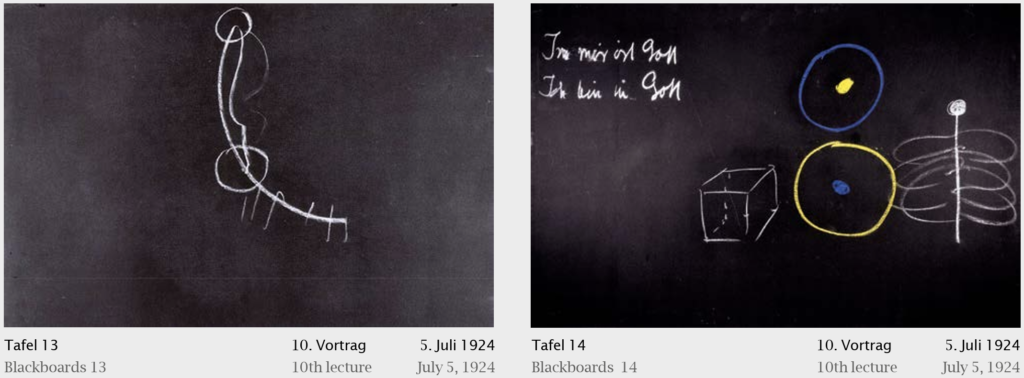
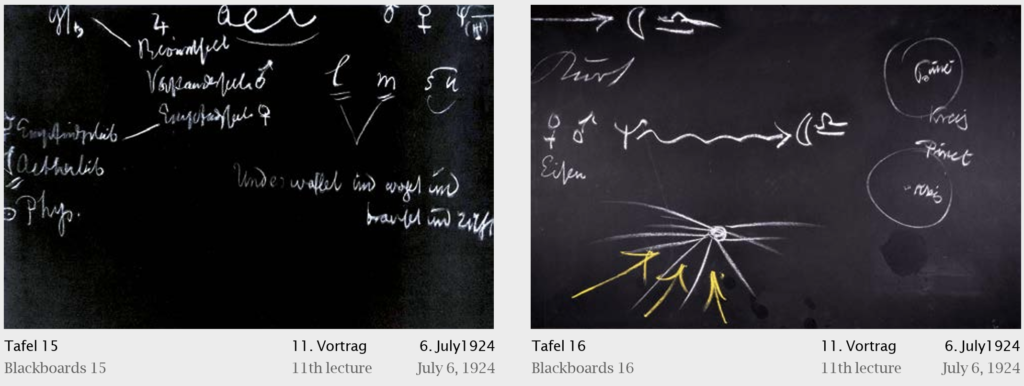
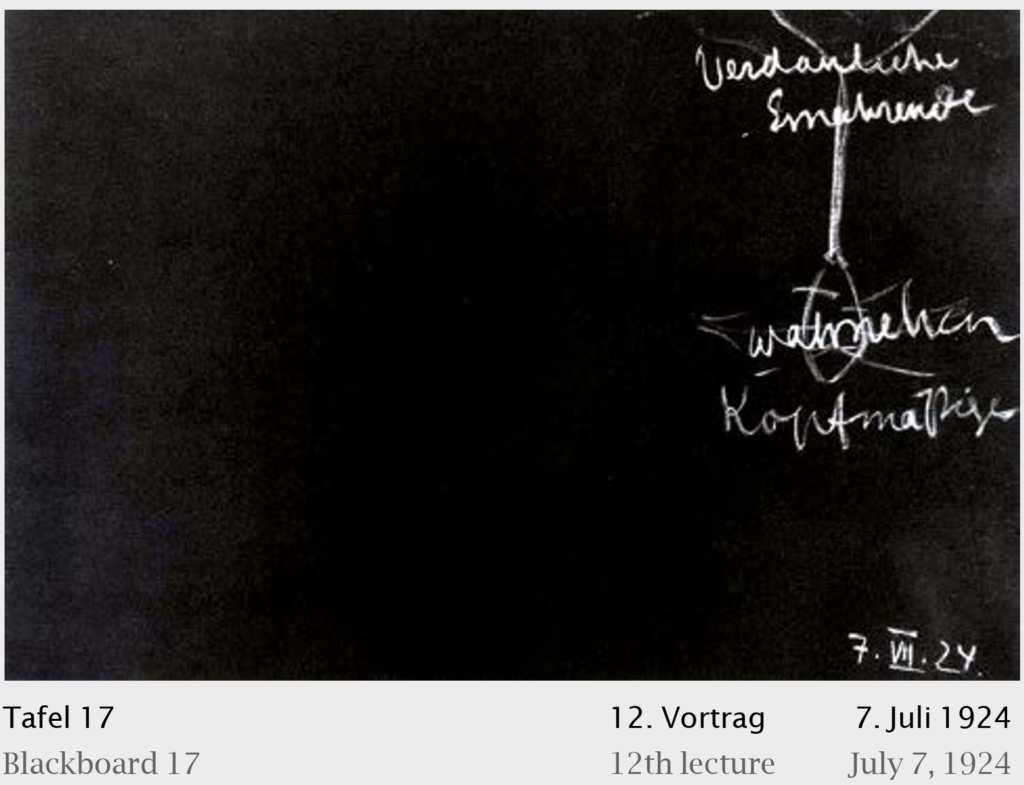
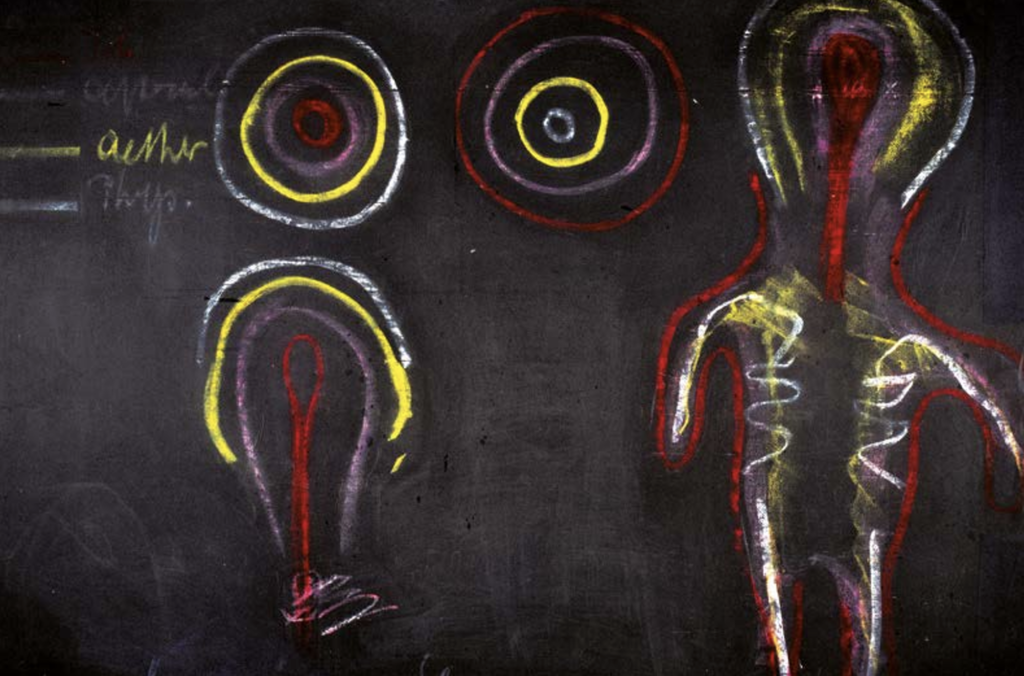
From June 25 to July 7, 1924, Rudolf Steiner gave twelve lectures on supportive education in Dornach. With this course, he was responding to the initiative of a number of quite young individuals who had founded a children’s home on the Lauenstein near Jena, which Rudolf Steiner visited on June 18, 1924. Some of the blackboards used in these lectures allow for several interpretations in the sequence of the individual drawings. The reconstructions of the sequences on blackboards 1, 2, 14, and 16 are presented here as they emerged during the editing work on the new German edition of the course. They are to be understood as a contribution to an ongoing discussion and are not intended to replace one’s own ever new contemplations and inward reflections on the drawings. This applies especially to the meditation on the point and the circle and the associated sentences «In me is God» and «I am in God.» Earlier notes by Rudolf Steiner from 1902 and 1906 are also briefly presented.
During the lectures of the Course on Education for Special Needs, black paper was placed on the blackboards, as was often the case, which is why these blackboard drawings still exist today. After the lecture, the drawings were fixated and dated, the sheets were removed, rolled up, and stored. The person who did this sometimes added the date and title of the lecture. These added dates and titles are therefore not by Rudolf Steiner himself. Seventeen blackboards from the Course on Education for Special Needs have been preserved. They measure approximately 90x140cm [3.0×4.5ft.]. It is clear in all cases which blackboards belong to which individual section of the lecture, as is the assignment of the individual drawings to the corresponding passages in the text. This has been indicated in the most recent German edition of the course (Heilpädagogischer Kurs, GA 317, 10th ed. Basel, 2025) and more detailed explanations are provided in the notes.
Hanging the Blackboards
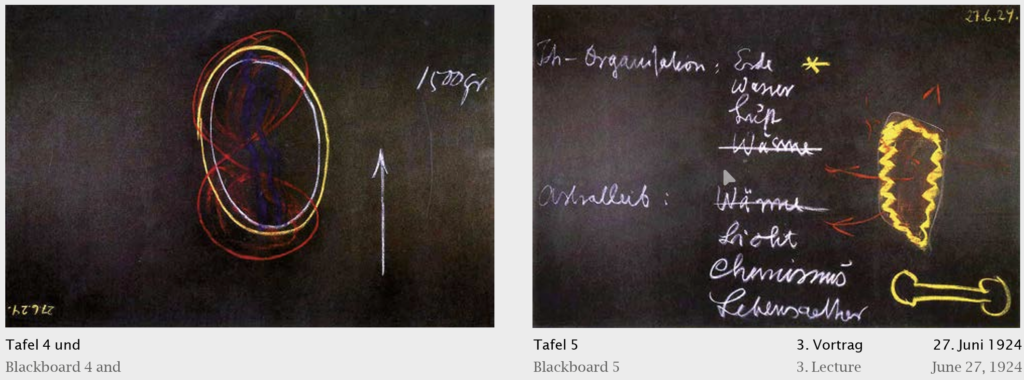
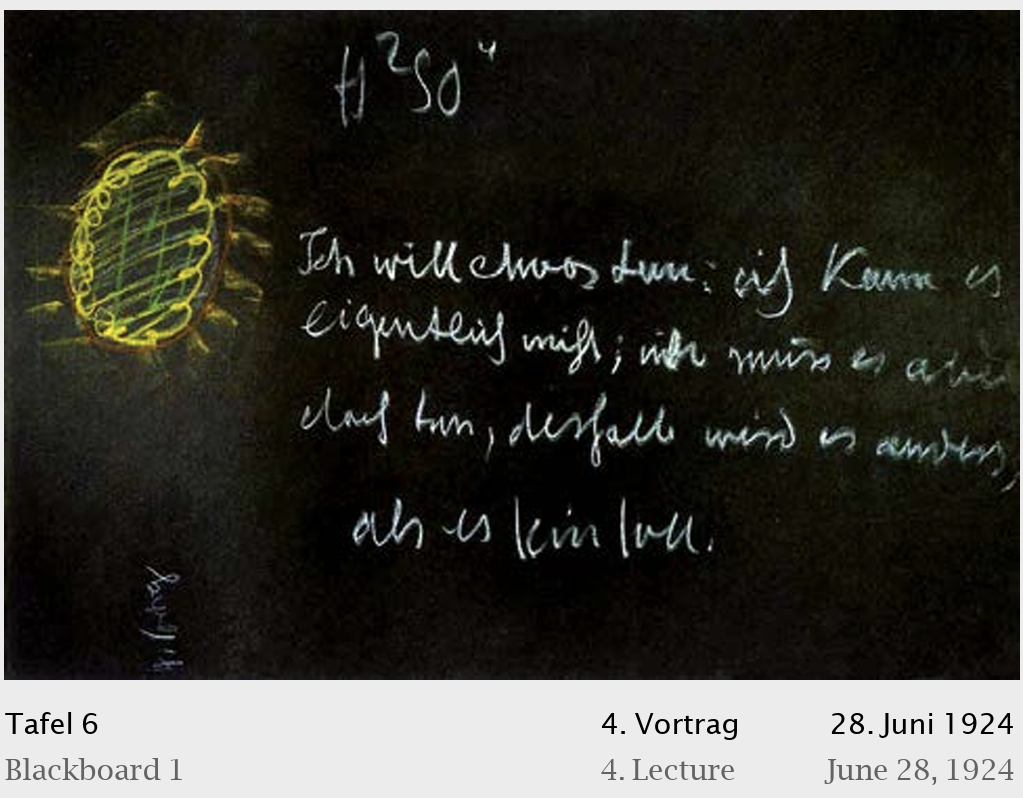
During a lecture, Rudolf Steiner sometimes used two blackboards, which presumably stood next to each other. Based on references to the blackboards in the lectures, it was possible to reconstruct how the blackboards were hung side by side, assuming they were used from left to right.(1)
Introductory Thoughts for Working with the Blackboards
It is not always clear how Rudolf Steiner worked on the blackboards. Since the sequences of how colors were used within a drawing have not been handed down, the exact development of some blackboards can leave room for interpretation due to the complex interrelationships. This is the case with the middle drawings on Blackboards 1, 2, 14, and 16. Reconstructing the step-by-step sequence of how the drawings were built up was part of the editing work; this is presented here. These attempts at reconstruction are only intended to be contributions to the ongoing discussion, adding to the different accounts currently available. (2) They are not intended to be universal instructions for understanding the blackboard drawings, but rather to show one possible order of steps that has emerged from an effort to comprehend the sequence of drawings. A prerequisite for working with the blackboards of the Course on Education for Special Needs is a thorough, repeated observation, ruminating, penetrating, and a willingness to understand the drawings. This can only be achieved by each individual for themselves. The following explanations are not intended to replace or take away from this effort, but, on the contrary, they are meant to encourage this individual process. During the editing of the new edition, it was often possible to experience how repeated observation led to a conversation about a drawing or raised a question, which was actually most fruitful and valuable. The individual drawing processes for the blackboards 1, 2, 14, and 16 are presented below. The reconstruction attempts are indicated by italicized insertions in square brackets within the text excerpts from the corresponding lectures.
I. Middle Drawings of Blackboards 1 and 2
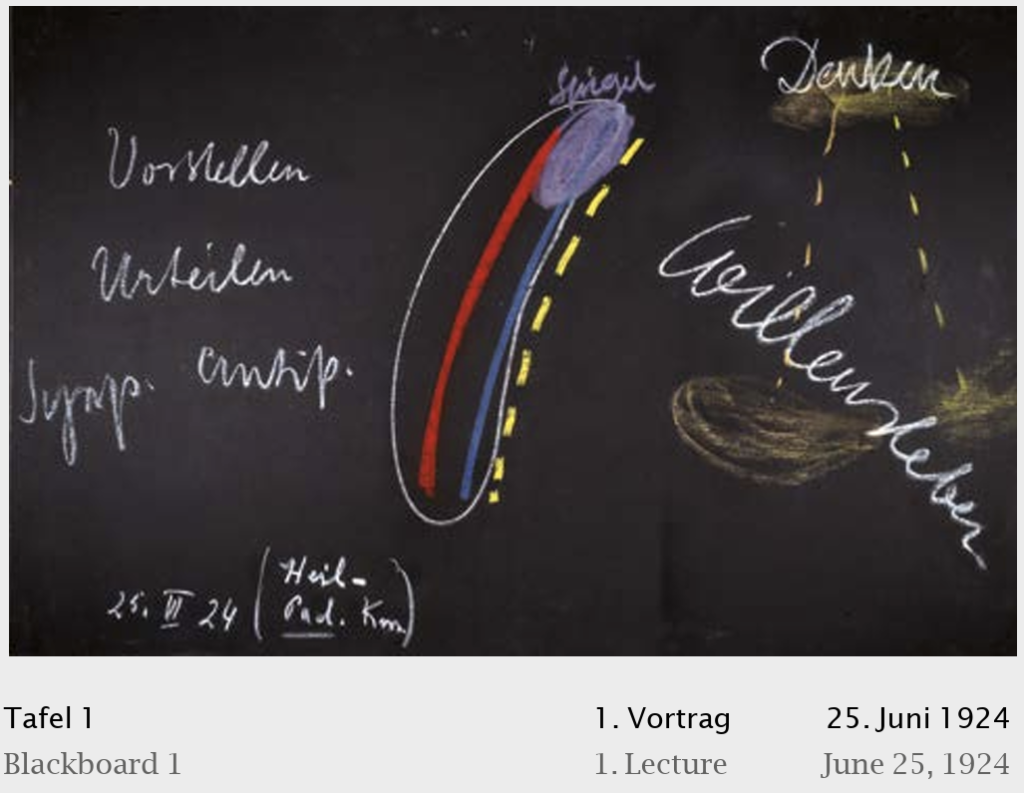
Blackboard 1, first lecture, June 25, 1924
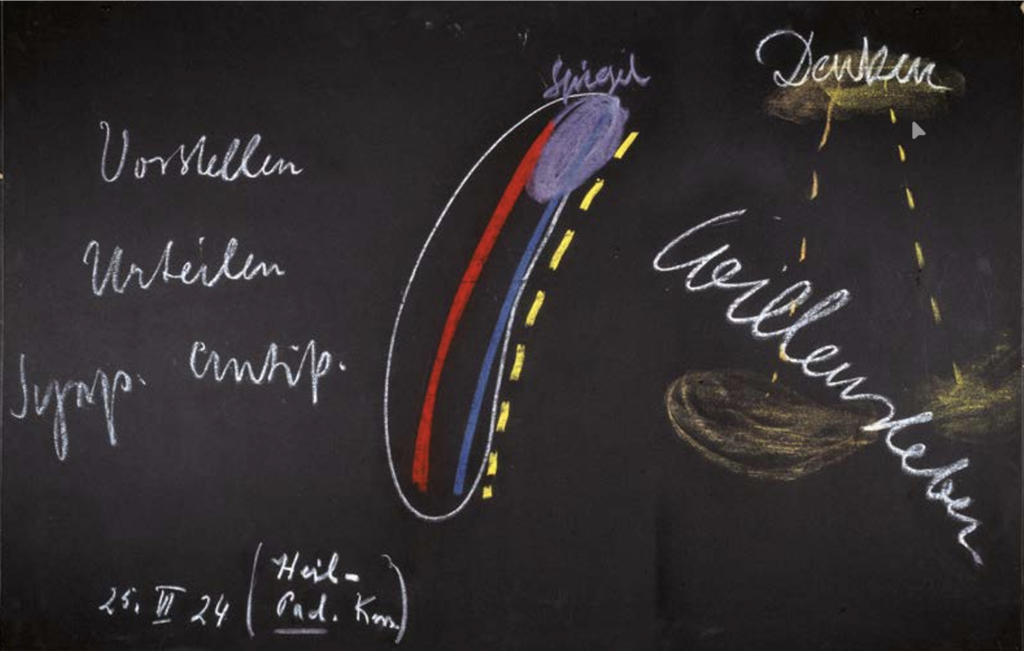
Sequence of drawing steps:
1. Blue: The enlivened physical body 2. Yellow: Symptomatic soul life, thinking, feeling, and willing 3. Red: «Actual soul life» coming from the spiritual world 4. White: Integrating gesture, connection of the «actual soul life» with the physical body. («Only when this connection is now here», p. 18). (3) 5. Violet: Mirror [Spiegel]
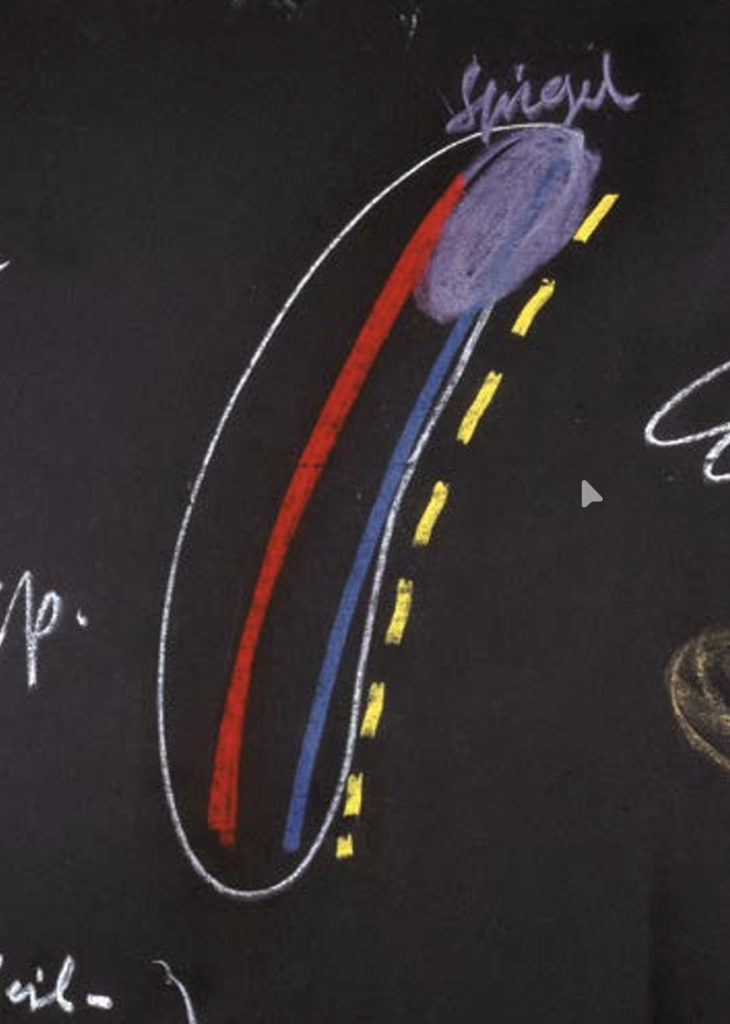
Blackboard 1, middle (detail)
Right at the beginning of the first lecture, Rudolf Steiner began drawing the middle drawing on Blackboard 1.
«Let us assume that we have here [drawing the blue line] the physical body of the human being, as it appears to us in the growth of a small child.» (p. 14) In the context of this blackboard drawing, the concept ‹physical body› refers to the physically visible body, which is always enlivened and permeated by the etheric body and is shaped by heredity. In the following passages, Rudolf Steiner used the following expressions in the same sense (p. 15f.):
- «the physical corporeality»
- «the physical body that is inherited and built up from the succession of generations»
- the physical body, where disease may be latent: «inherited in the physical and etheric bodies»
- «what has been inherited»
- «organization of the body»
The main theme in this section is how the actual soul life descends from the spiritual world and connects with the developing body during the embryonic period. The complex formation of the physical body itself was not discussed in detail in this lecture.
«We then have [drawing the yellow dotted line] the life of the soul—ascending in a sense—emerging from this physical body of the human being.» (p. 14)
After a discussion on the relativity of the concepts of normality and abnormality in human soul life, Rudolf Steiner presented «what is average and normal» (p. 14) by completing the middle drawing on Blackboard 1.
«You see, if we disregard this [yellow dotted line] soul life, which in any case gradually emerges more and more, and in some cases is influenced by highly dubious educators—if we disregard this soul life [yellow], then behind the physical corporeality [blue] we have another soul-spiritual life [the actual soul life, which is drawn two sentences later as a red line], a soul-spiritual life that descends from the spiritual worlds between conception and birth—this soul life [yellow] is not what descends from the soul-spiritual worlds.
Rather, it is a different soul life that is not immediately visible to earthly consciousness. I will sketch it schematically behind it [drawing the red line from top to bottom]. This whole soul life that descends [tracing the red line from top to bottom] takes possession of the physical body that is inherited and built up from the succession of generations [blue].
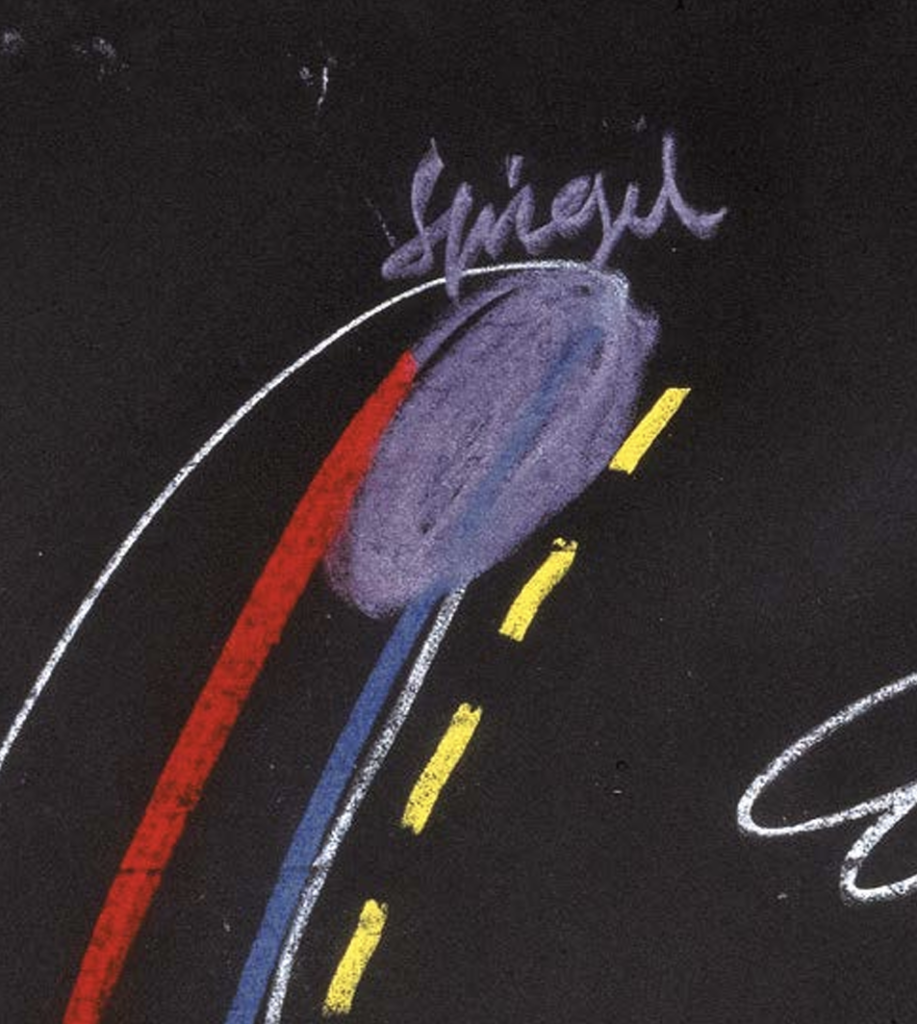
Blackboard 1, middle (detail)
So, when this soul life [Pointing to the red line] is such that it constitutes a diseased liver, that it affects the liver substance, or finds something pathological in the physical and etheric bodies [blue] due to heredity, and therefore an inner sensation of illness arises, then a disease is present. Likewise, any other organ or organ complex may be improperly activated by what descends from the soul-spiritual cosmos.
And only when this connection is established here, [white, encompassing the red and blue lines with white chalk] this connection between what descends [red] and what is inherited [blue], when this psycho-physical corporeality has formed, then what arises—more as a mirror image, though—this is what our soul life is and what is usually observed as thinking, feeling, and willing [yellow]. This thinking, feeling, and willing are, in fact, only there as mirror images, truly like mirror images, and they are erased when we fall asleep. The actual enduring soul life [red] is behind it, descends, passes through repeated Earth lives, and sits within the organization of the body [blue]. And how does it sit within?» (p. 15f.)
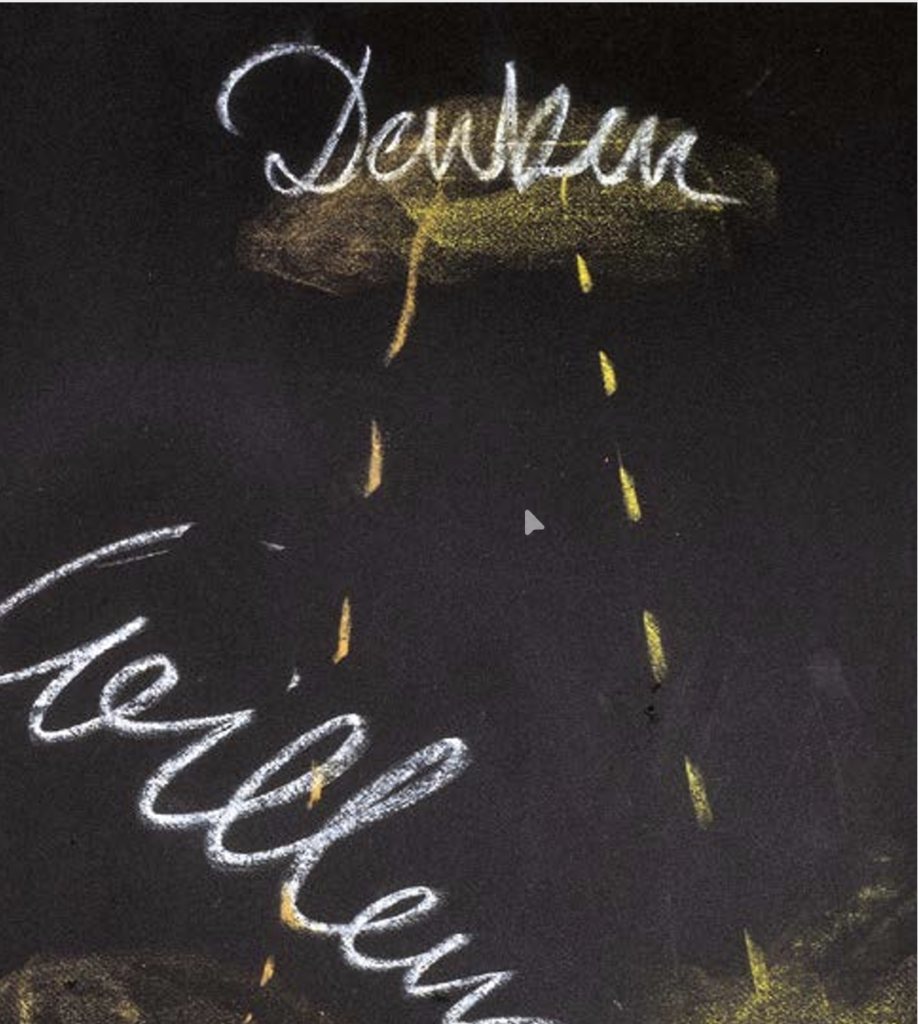
Blackboard 1, right (detail)
Following a brief examination of the nerve-sense system, the rhythmic system, and the metabolic-limb system, Rudolf Steiner goes on to indicate the polarity of the synthetic and analytic modes of activity and sketches this in the drawing on the right on Blackboard 1. The «convergence,» the «synthetic activity of the head» [Blackboard 1, right drawing above] is the basis of «all thinking activity.» This «synthetically articulated inherited substance» is the violet mirror (Spiegel) in the middle drawing. Rudolf Steiner now returns to the middle drawing. «In order that human beings are able to think, what comes from the soul-spiritual realm—what enables human beings to come forth and become active—has to acquire a summative function in the head, and thereby has to establish an articulated synthesis of the genetic material. And as a result, a mirror can then be seen in the synthetically articulated genetic material. [Middle, violet mirror connecting the red and blue lines.]
So now, you have the following: when this enters into the head during the descent, so that the head synthetically organizes it, thus the head becomes a mirror [middle, «mirror»], and therein it mirrors the outside world, and this gives the thinking [middle, yellow] that we usually observe. So we have to distinguish between the two thinking functions, the one that lies behind what is perceptible [red], which the brain [violet] builds up—which is what endures—and the thinking function that is not based on any reality at all, that is only reflected [yellow] and is perpetually erased when we fall asleep and goes away when we are no longer thinking about something.» (p. 17) Rudolf Steiner then returned to the drawing on the righthand side of Blackboard 1. He described the analytic design of the metabolic-limb man (Blackboard 1, right), with its clearly distinguishable individual contours, before continuing the lecture with other topics. In the second lecture, Rudolf Steiner returned to the middle drawing and redrew it on the blackboard in a different form.
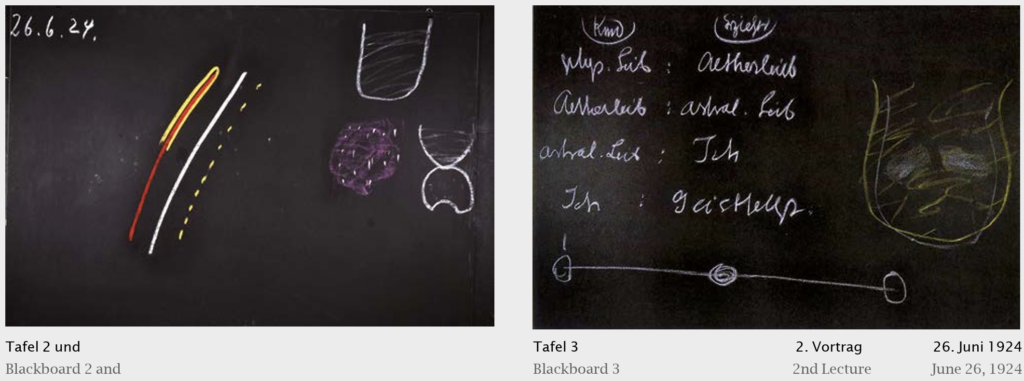
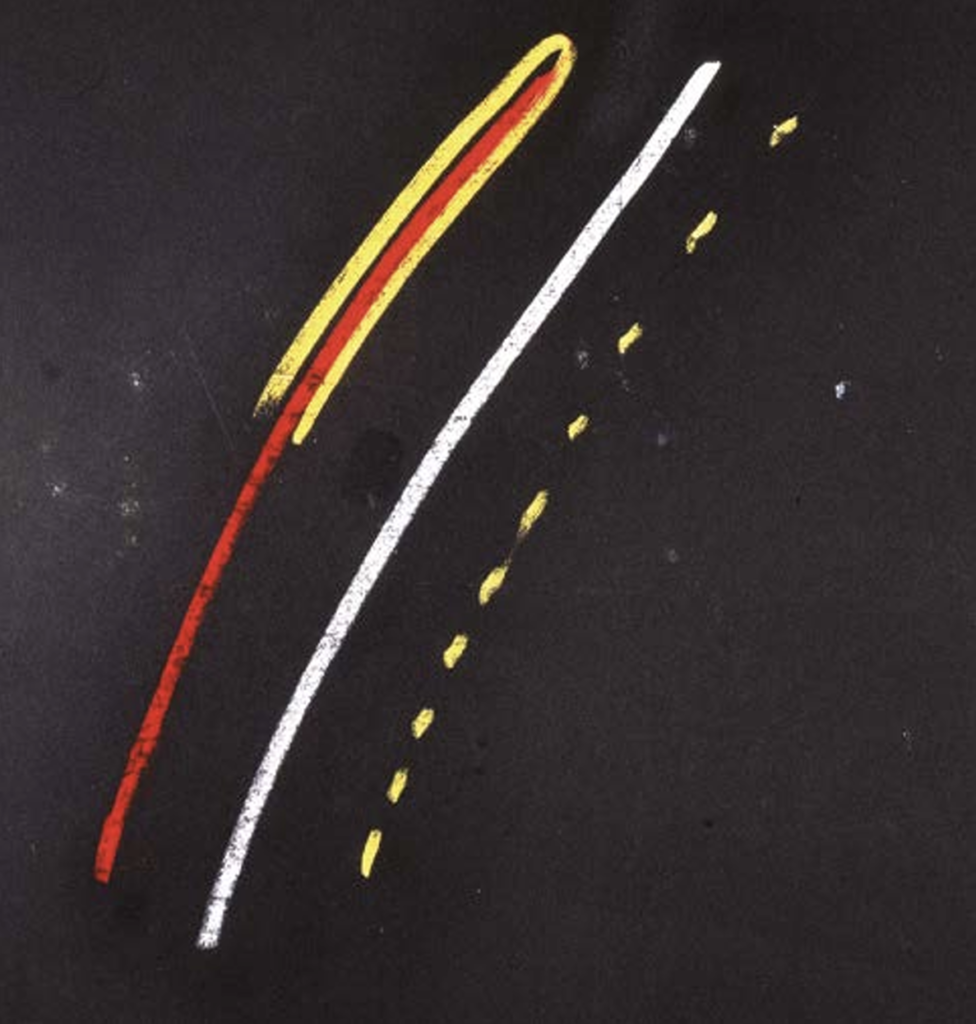
Blackboard 2, second lecture, June 26, 1924
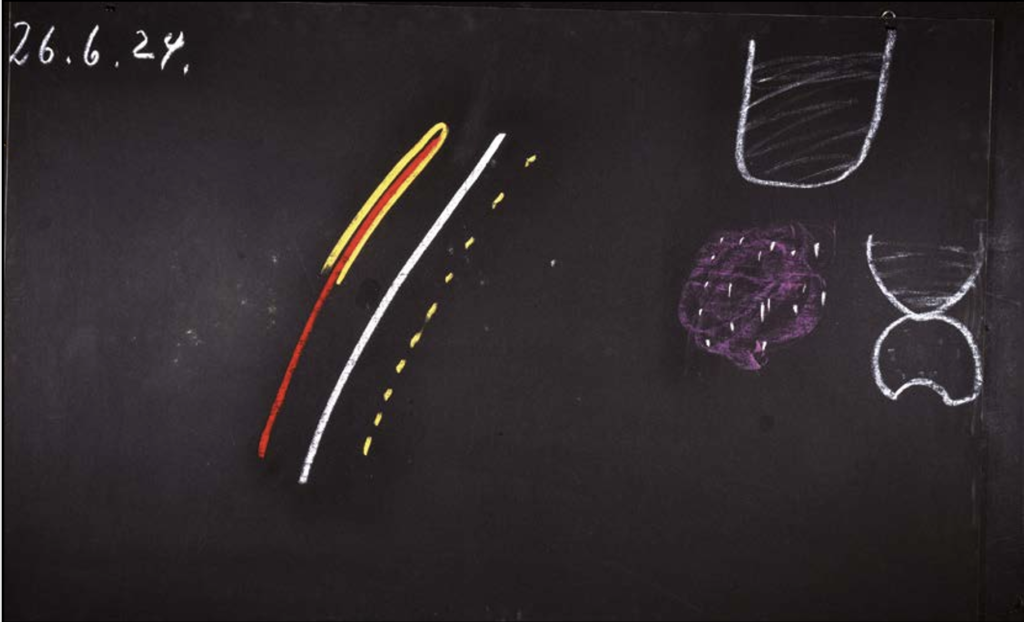
Sequence of drawing steps:
1. White: The human being 2. Yellow dotted line: Symptomatic soul life (thinking, feeling, and willing) 3. Red: Behind this, the real, spiritual soul life 4. Yellow ‹cap›: Thoughts from the general world ether, as described in the previous paragraph as part of real soul life, as living thoughts.
Blackboard 2, middle (detail)
In the middle of the second lecture (p. 32f.), Rudolf Steiner returned to the middle chalkboard drawing from the first lecture. The paper on the blackboard with the drawing from the lecture the day before had been removed, so he redrew it in a different way, reminding those present of it. He chose the colors freely, without reference to the colors from the previous day.
«So if I repeat yesterday’s diagram, if you see the human being here [drawing the white line], if we have here [drawing the yellow dotted line] the symptomatic soul life, thinking, feeling, willing, if we have behind that the soul life, the real soul life [drawing the red line], then we have a part of the real soul life in the thinking [drawing the yellow ‹cap,› encompassing the red line above]. And this thinking, which we take from the general world ether, is formed primarily by our brain and, in a broader sense, by our nerve-sense system. This is the living thinking, which fashions the brain in us into an organ of decomposition, into the organ that, in a sense, handles matter in the following way.
You see, when we look out at our surroundings, we see the substance of the earthly world around us in its various processes and ways of working. These processes, which live in nature, are gradually broken down by the activity of living thinking, so that there is a continuous breakdown here [yellow ‹cap› around the red line], that is, the processes are stopped, those processes of nature. So, in the brain, a beginning is made in that the natural processes are stopped, and the matter is continuously separated and secreted out.» [Blackboard 2, right, drawing of the purple pile of color with white points] (p. 32f.)
II. Blackboard Drawings: Point and Circumference
Blackboard 14
Blackboard 16, right (detail)
Blackboard 7
Notebook, NB615, p.30
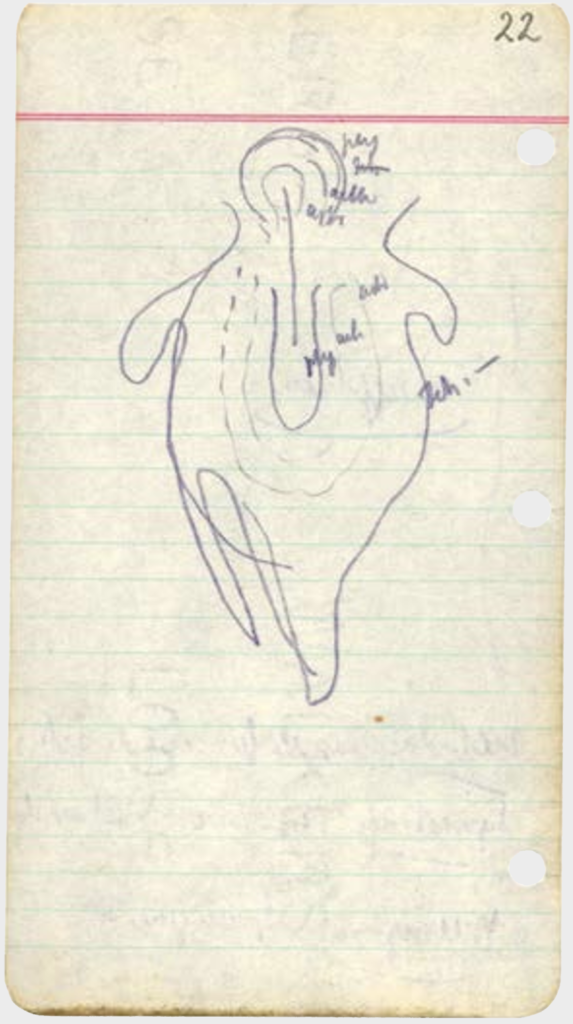
The meditation on the point and circumference, as presented by Rudolf Steiner in the tenth and other lectures of the Course on Education for Special Needs, has a central significance to the course as a whole. What was written in the introduction here also applies to this meditation: ever and again, we must reflect on, move, and contemplate it ever anew. Here, we will focus primarily on how the blackboard sketches may have developed step by step in the course of the lecture. Consequently, the order in the text is crucial. This analysis focuses on Blackboard 14, the right-hand side of Blackboard 16, and Blackboard 7. It is helpful to have all these drawings in view all together. Sketches in notebooks such as those in notebook NB 615 or NB 105 (see p. 47/49) also belong in the context of what is being discussed here.
Traces in Notebooks and Notes
Before discussing Blackboard 14 in detail, a few of Rudolf Steiner’s earlier notes, which refer to a point-circumference meditation, should be mentioned briefly. Rudolf Steiner’s first notes on this meditation can be traced back to 1902, twenty-one years before his first conversation with the founders of Lauenstein during the Christmas Conference of 1923/24. In 1902, Rudolf Steiner wrote the following lines in his notebook: «No one wise speaks the sentence: God is in me, without adding: I am in God; and if it is necessary that he say only the first sentence, then he thinks the second as well, thereby the first godlessness dies upon his lips.» (NB 216, p. 75) (4)
In 1906, Rudolf Steiner wrote further notes while reading the book Light on the Path by Mabel Collins: (5)
«With such mental pictures, it is important to always keep the counter-thought in consciousness: inner peace is never to be bought by turning away from the outer world, but rather only after continuously harmonizing with the outside world. This is just like, for example, two other polar thoughts; the esotericist never thinks or speaks one or the other without at least faintly, in the background, striking upon the corresponding counter pole. If, for example, I say, God is in me, then I should at least subtly think, I am in God. Thereby, the one-sided thought form is continuously paralyzed by its corresponding other, just as, for example, the physical body is by the ether body.» (NB 105, p. 13 from 1906)
Note NZ 7178
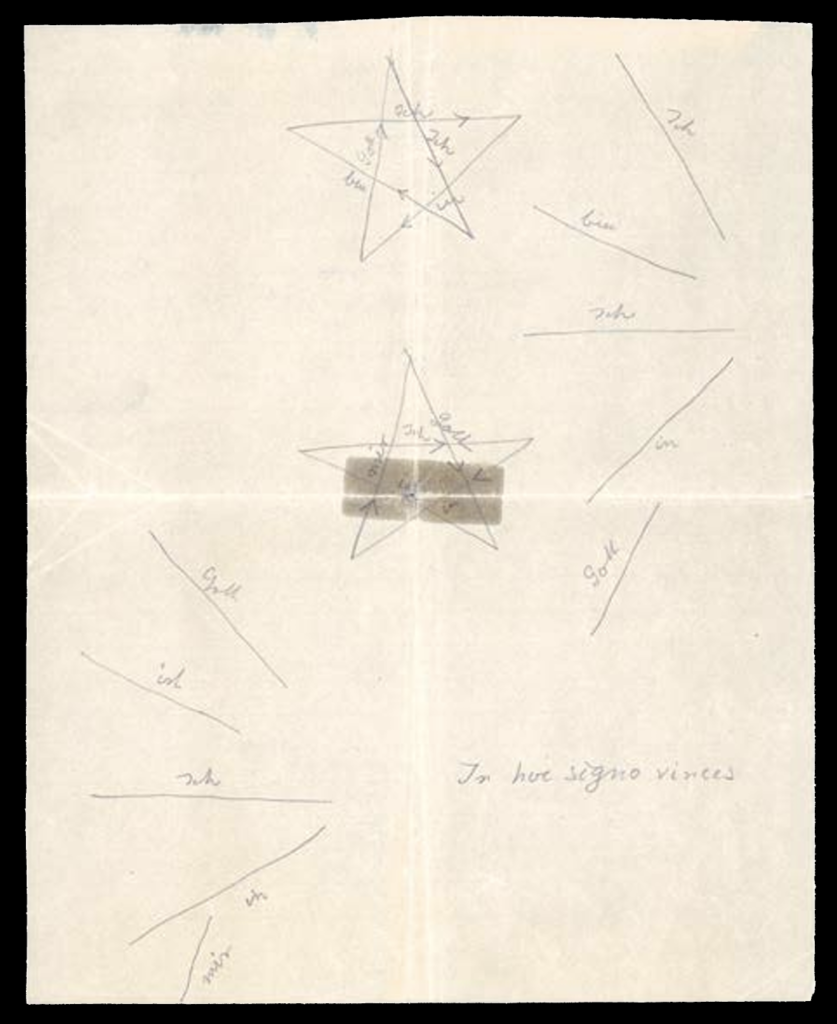
For Ita Wegman, Rudolf Steiner wrote the sentences «I am I in God» [Ich bin Ich in Gott] and «God is I in me» [Gott ist Ich in mir] on an undated note, enclosed within drawings of five-pointed stars and accompanied by «In hoc signo vinces» [Latin: In this sign you will conquer] (NZ 7178).
Notebook NB 105, p.86
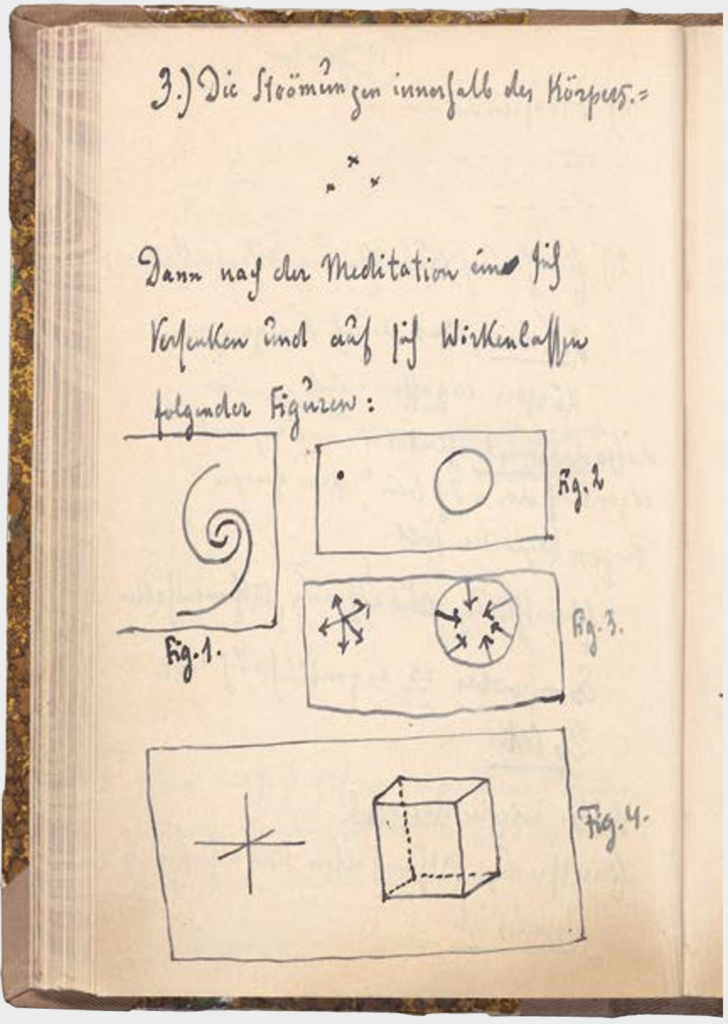
A few pages later in the aforementioned notebook NB 105 (pp. 86–88),6 Rudolf Steiner sketched the following in 1906, after three preliminary exercises: «Then, after meditation, sink down into yourself and allow the following figures to work upon you.» Two of these figures are a point and a circle (Fig. 2) and centripetal and centrifugal forces (Fig. 3). He noted the following about both sketches: «Fig. 2: How does the point become circle, and how the circle, a point? / Fig. 3: What is inner, what is outer; what is upper, what is lower; what is matter, what is spirit; what is physical substance, what is ether?»
Rudolf Steiner expanded on these early thoughts concerning the spiritual background of polarities in his Course on Education for Special Needs, adding an anthropological perspective and referring to further transformations, such as those in the spiritual biography of Pope Gregory VII/Ernst Haeckel in relation to Rome/Jena (p. 195).
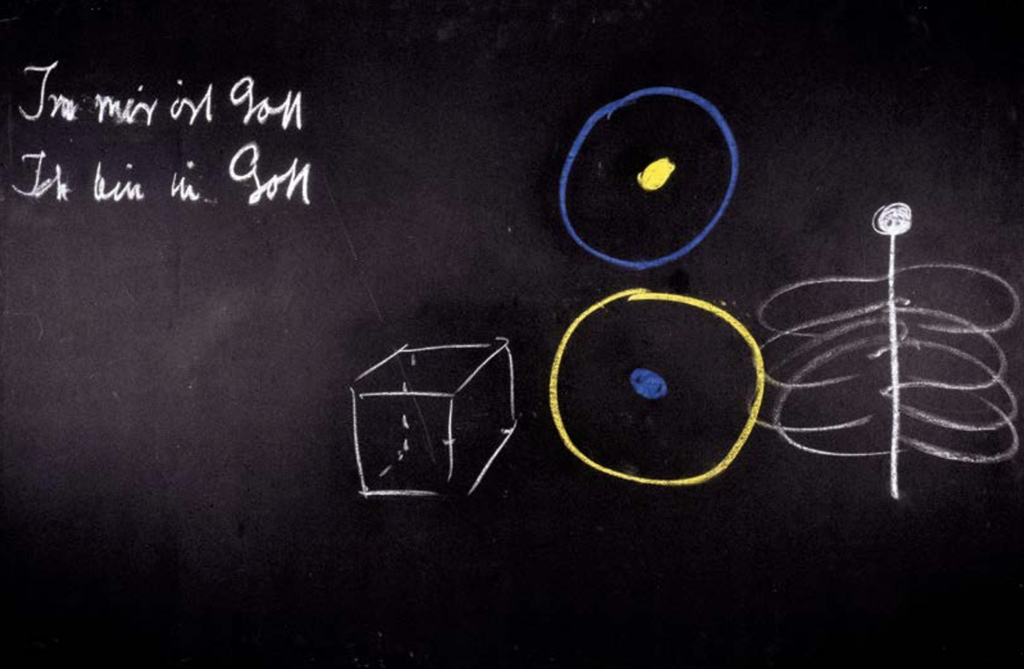
Blackboard 14, tenth lecture, July 5, 1924
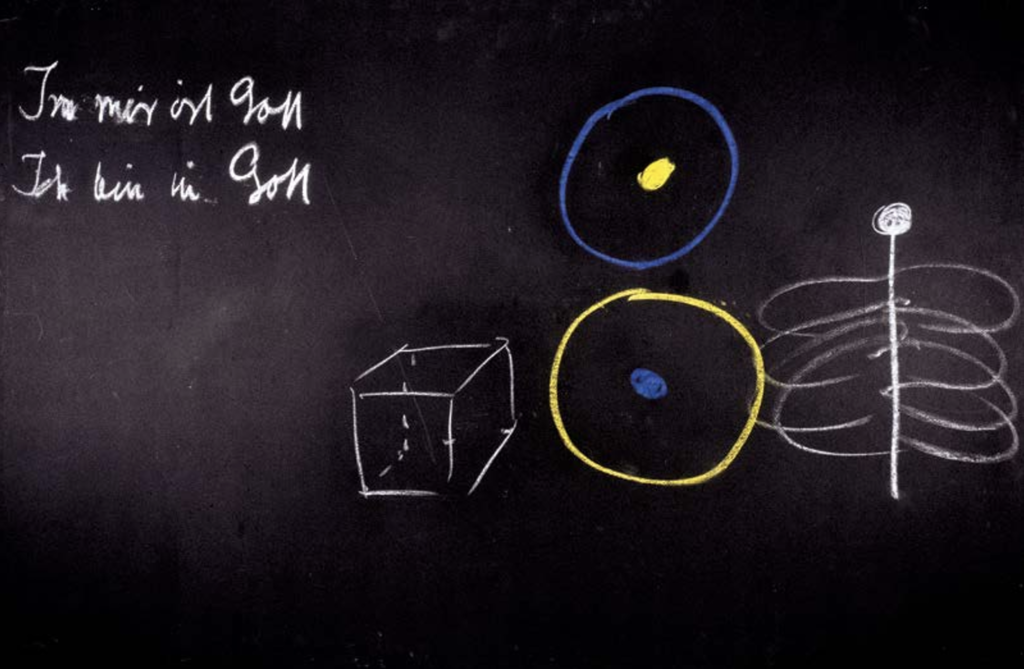
The assignment of the individual stages of the drawing to the wording of the lecture is only partially clear, particularly with Blackboard 14. Various explanations are plausible and make sense. Key considerations have already been made in this regard in the past. (7) It is important that Rudolf Steiner links the rather brief indications for this meditation to the call to develop a courageous consciousness of an appropriate «I can do this» attitude that wants to intervene in the world—a linking-up with the work of the gods, which can awaken both humility and enthusiasm. The meditations aim to lead to what is described as «devotion to the small things»: «You must think about what an enormous difficulty this presents. The person who is to tell someone something based on intuitive insight—the thing is not plain to see, and what the layman says is usually wrong when it comes to underdeveloped children. It comes down to seeing through to what is actually there—for this you need something, for this you need to tell yourself in an energetic, courageous way, not just in the moment, but as a continuous qualitative content of your consciousness: “I can do this.” When you say this to yourself again and again without vanity, even with a willingness to make sacrifices, overcoming the things that stand against you, if you don’t just feel it, then you will see how much you are capable of in this direction.» (8) (p. 171)
1. «In me is God,» «I am in God.»
First, Rudolf Steiner wrote the two sentences «In me is God» [In mir ist Gott] and «I am in God» [Ich bin in Gott] in the upper left corner of Blackboard 14. The first sentence is to be contemplated in the evening. The soul can consciously orient itself toward the events of the night ahead. The second sentence is to be brought into one’s conscious- ness in the morning. Thus, the awakening soul can establish an appropriate relationship to the events of the day.
2 .Drawing circle and point
Then, in a second step, these sentences were drawn on the board in pictorial form.
In me is God (evenings):
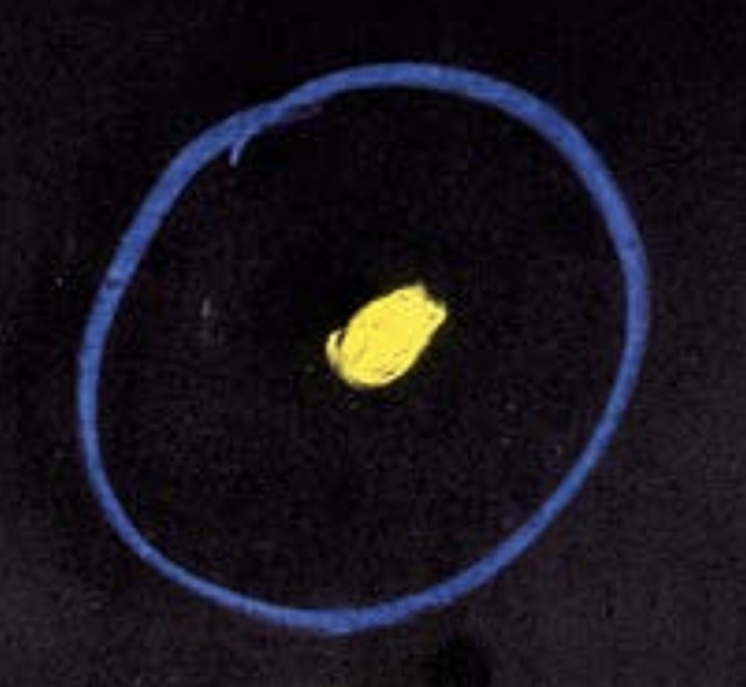
I am in God (mornings):
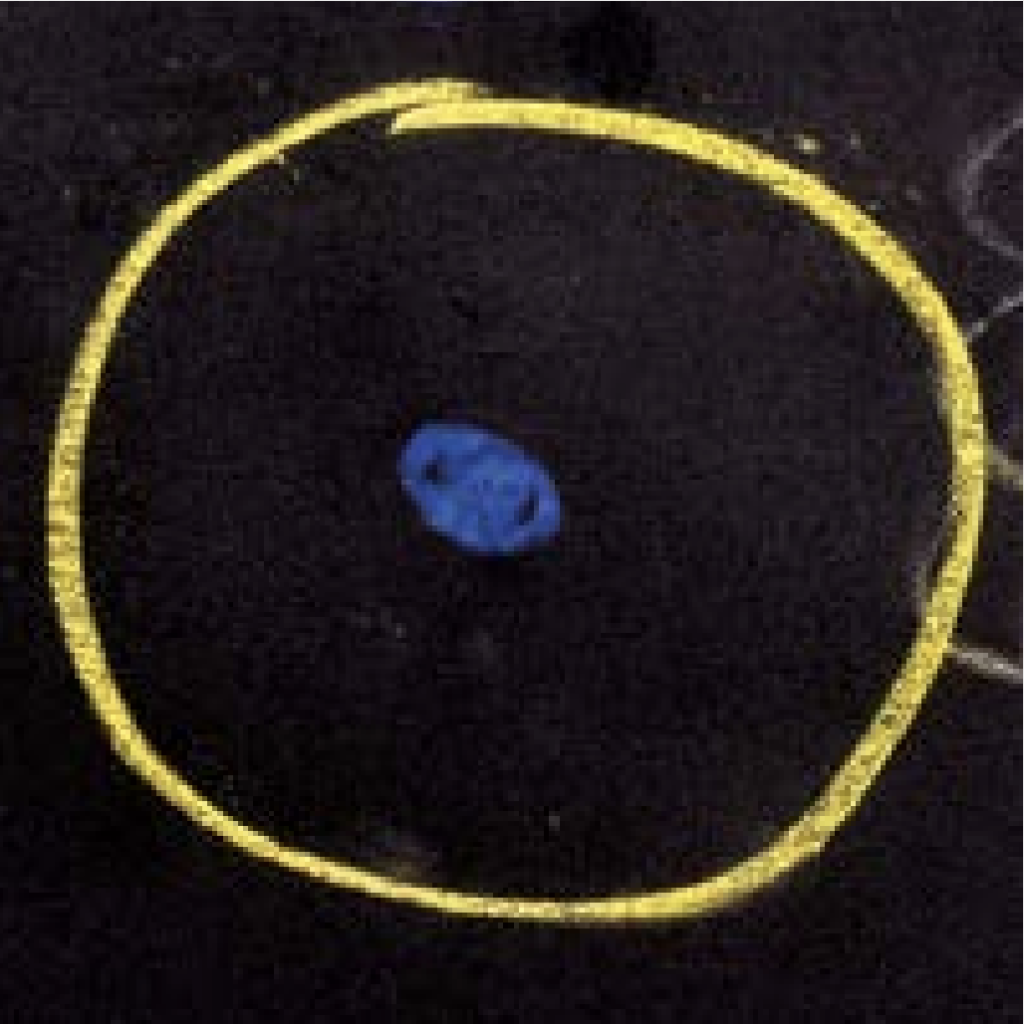
«Think about what you are actually doing when you activate these two conceptions, which wholly become inner sensations, yes, impulses of will, within yourself. What you are doing is making this image stand before you. In me is God, and the next morning you have this image before you: I am in God. It is one and the same, the upper and lower figures.»
3. Initial explanations on circle and point: Rudolf Steiner first points out here the identity of the upper and lower figures, to the circle as a circle and the point as a point. This prepares the ground for the dynamic change between circle and point discussed later. Already in these small sketches, it is striking that the circle does not enclose a geometric, dot-like point—the point is drawn too expansively for that—so that, purely in terms of drawing, the center already forms an appropriate counterweight to the circumference. This is even more clearly expressed in Blackboard 7 (see p. 47): there, the center is represented as a small circle. The layout of the drawings on Blackboard 14 is the same in both sketches, but the colors are reversed: blue is used instead of yellow and vice versa.
4. Observation on the identity of circle and point
There are no reliable indications in the source texts as to which circle and which point Rudolf Steiner indicated in detail in the following passage. Several variants seem conceivable and plausible. Possible variants are briefly presented here.
Variant A: «And you simply have to understand: this is a circle [yellow point], this is a point [yellow circle]. This only comes out in the evening [referring to upper middle], this only comes out in the morning [referring to lower middle].» (Transformation between point and circle within the yellow color)
Variant B: «And you simply have to understand: this is a circle [yellow circle], this is a point [yellow point]. This only comes out in the evening [referring to the upper middle], this only comes out in the morning [referring to the lower middle].» (Referring to yellow color, without transformation between point and circle)
Variant C: «And you simply have to understand: this is a circle [yellow point], this is a point [blue circle]. This only comes out in the evening [referring to the upper middle], this only comes out in the morning [referring to the lower middle].» (Referring to both colors in the upper figure, transforming back-and-forth between point and circle)
5. Dynamic transformation between evening and morning
The following sentence, «In the morning, you have to think…», refers to the morning. It can therefore be presumed that the preceding sentence, «And you simply have to understand…», was discussing the evening. The authors here thus prefer Variant C. The other options (A and B) will not be pursued further in this article.
Taking Variant C, the following allocation applies: «In the morning, you must think: This is a circle [blue point], this is a point [yellow circle]. You simply have to understand that a circle is a point, a point is a circle.»
With these statements and references, Rudolf Steiner has brought the whole presentation into dynamic movement. For example, the evening circle is metamorphosed by the events of the night and appears the next morning as the point. It comes down to how one thing transforms into another. This depiction makes it clear that the morning can only be understood from the night, because the blue circle of the evening figure is transformed by the events of the night into the blue point of the morning. The drawings take on a dynamic movement.
6. Point and circle as the effectivity of forces
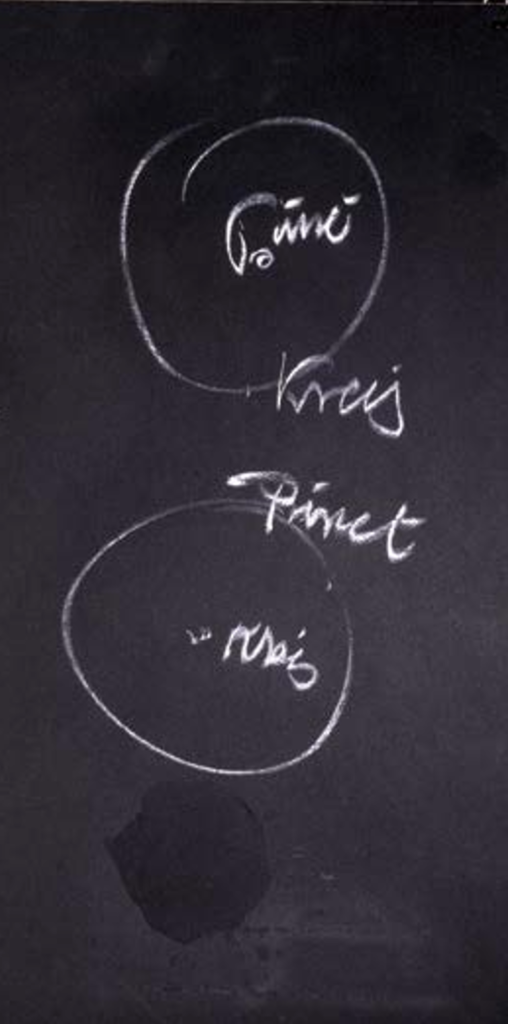
This metamorphosis (section 5 above) is taken up again in the 11th lecture on Blackboard 16 (far right figure), where Rudolf Steiner describes the center as a point, but in the lower drawing he designates the circular periphery, the circle, as a point.
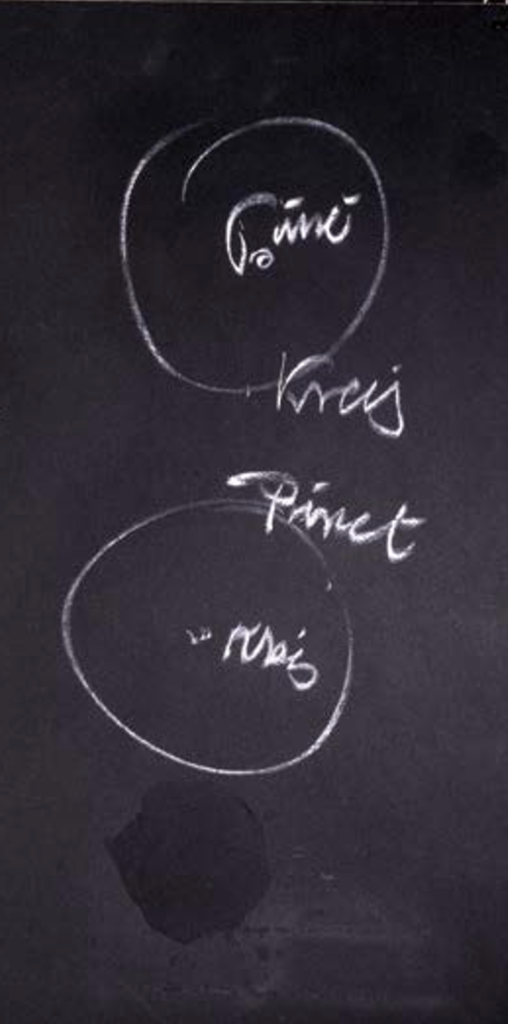
Blackboard 16, right (detail)
This last illustration makes it even clearer that the concepts of point and circle should be thought of as the effectivity of forces: the point as something expanding centrifugally out to the circumference, an eversion; the circle as a centripetal effectivity striving in toward the center.
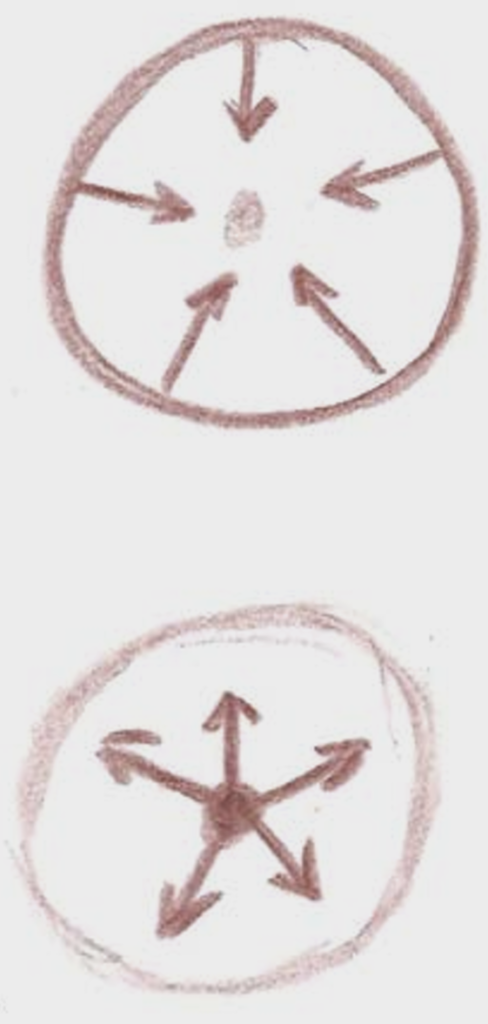
Above, centripetal; below centrifugal
Thus, points and circles are not static, but rather mobile processes. According to Rudolf Steiner, engaging with this fundamental image is not merely to be carried out as a geometric thought exercise, but rather is to be «wholly understood inwardly» from an anthropological perspective.
7. Assigning evening and morning to the head and limb system of the human being
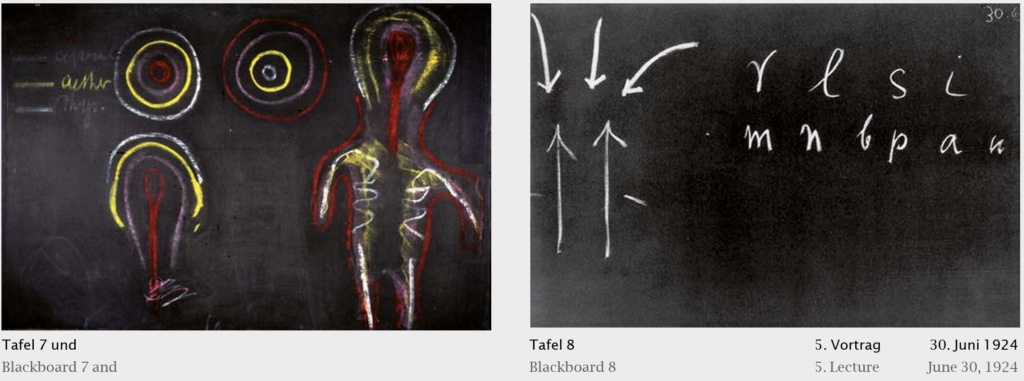
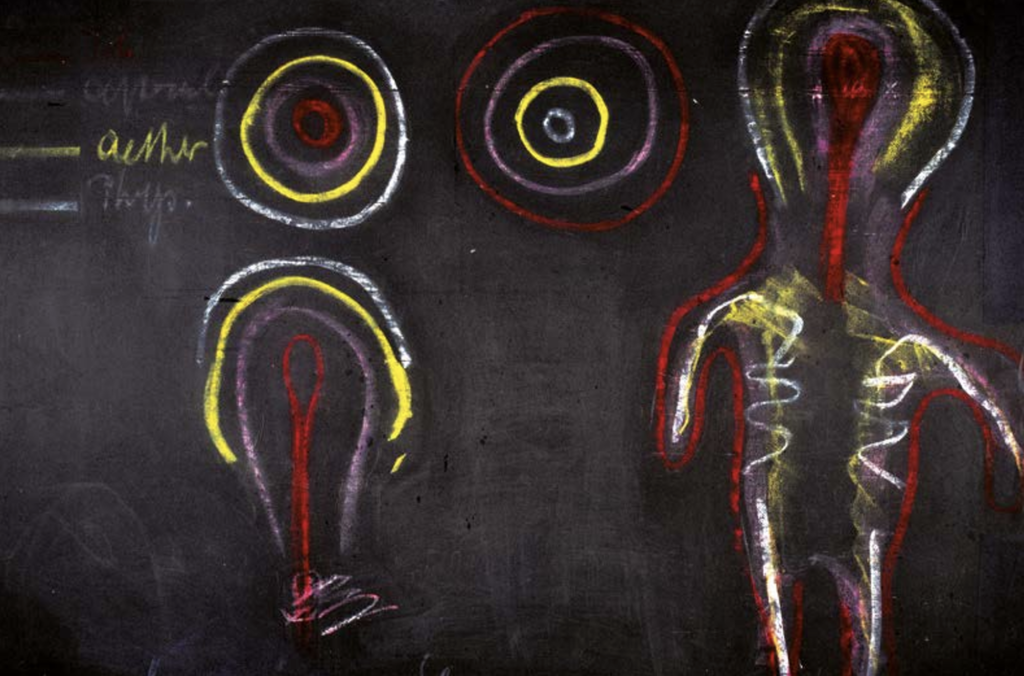
7a) Steps of the drawing: In the following step, the previous circle and point representations were brought into relationship with the head and metabolic-limb system by referring to the representation in the fifth lecture (Blackboard 7).
Blackboard 7
In Blackboard 7, the head man (left) is drawn with the red inner circle for the ‹I›; it is a schematic representation of the ‹I›-point. This correlates with the yellow ‹I›-point in the upper, «evening» drawing on Blackboard 14.
The ‹I›-point of the head is clearly explained in Blackboard 7 by the diagram on the far left, i.e., the drawing on the left depicts the head man with a red ‹I›-point. This ‹I›-point in the head man in Blackboard 7 is identical to the yellow point in Blackboard 14; the upper drawing in Blackboard 14 depicts the head man.
«This is realized in human beings in that the ‘I’-point of the head becomes a circle in the limb man.»
This means that, in Blackboard 7, the red point on the head metamorphoses into the red circle of the metabolic-limb man in the middle drawing. Likewise, in Blackboard 14, the yellow point in the upper drawing of the head man transforms into the yellow circle of the metabolism-limb man.
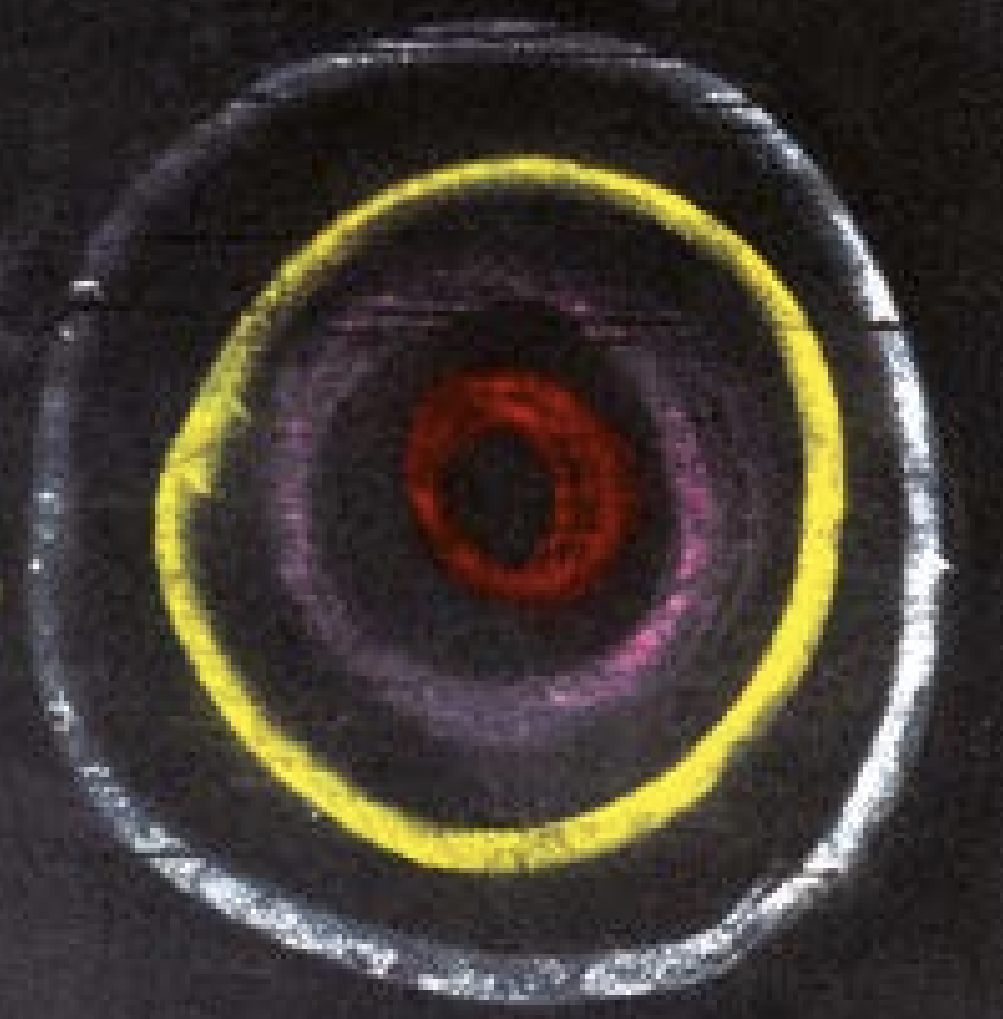
‹In me is God.›
The line «In me is God» [top left] with the upper drawing on Blackboard 14 [yellow point, blue circle], which is to be brought into consciousness in the evening, correlates with the head man on Blackboard 7 [right drawing, top part].
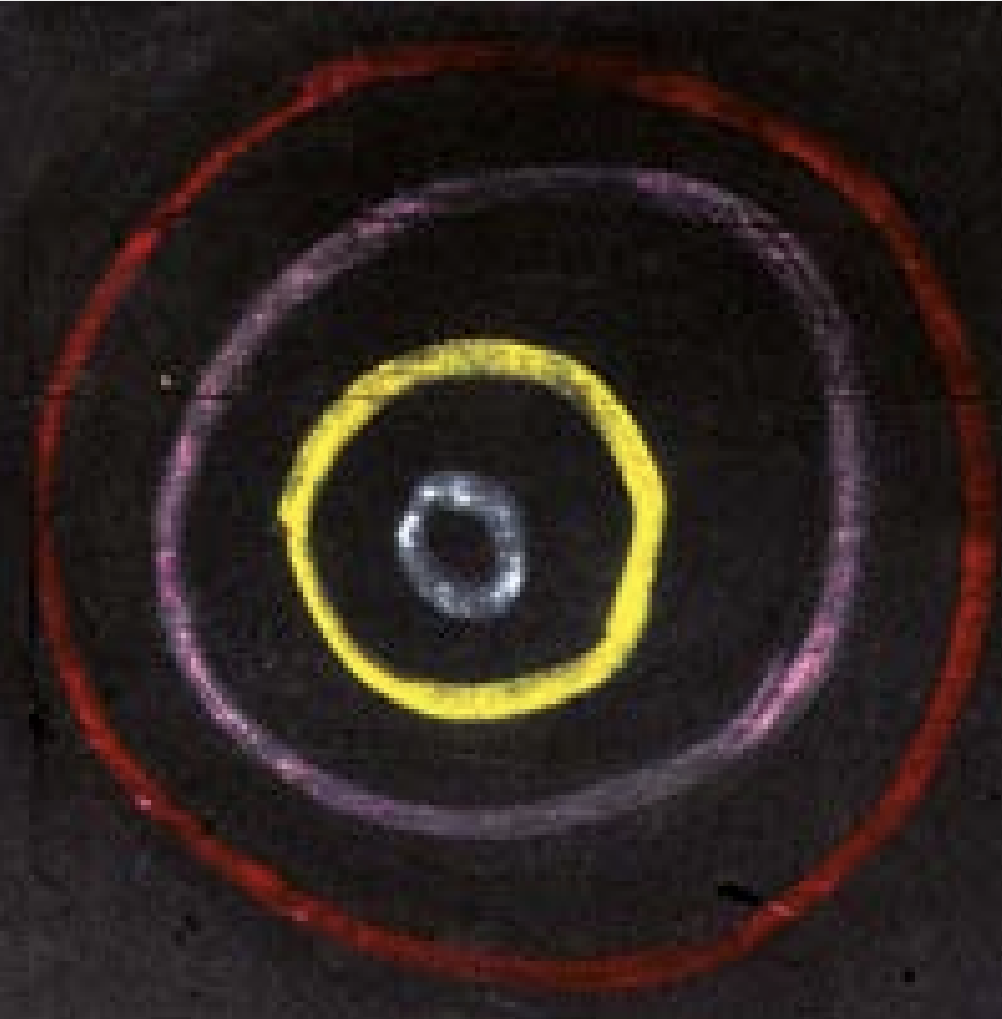
‹I am in God›
The line «I am in God» [bottom left] with the lower drawing on Blackboard 14 [blue point, yellow circle], which is to be moved meditatively in the morning, correlates with the metabolism-limb man on Blackboard 7 [left, lower half and middle top sketch].
7b) Regarding the anthropological background: These point-circle representations have a broad anthropological background. Of the many aspects that come into consideration here, only a few will be mentioned.
Evenings: The consciousness of «In me is God» is directed from two sides toward something that is not immediately apparent to daily consciousness: (9)
- On the one side, the beings that create and sustain the body use their forces at night to plunge deeper into the physical and etheric bodies remaining in bed in order to regenerate them and to compensate for the breakdown and disorder caused by the events of the day.
- On the other side, I have absorbed numerous events and experiences from the daytime world into my soul. At night, my ‹I› and astral body—freed from the constraints of the physical and etheric bodies—will newly work through the events and experiences of the day in collaboration with the hierarchical beings of the night, thereby building up a moral re-evaluation that will affect the following day.
Mornings: The bottom sentence, «I am in God,» and the lower drawing on Blackboard 14 is related to the sketch of the metabolism-limb man on Blackboard 7 [Blackboard 7, middle and bottom right]. The spirit-soul, i.e., the ‹I› and the astral body, reconnects with the physical and etheric bodies in the morning and will increasingly permeate them throughout the day. They carry the impulses from the night into daily life. Here, too, consciousness can turn in two directions:
- On the one side, it leads me out into the social sphere, to encounters with my environment, with my fellow human beings, and with very concrete relationships of destiny. After a night’s sleep, I encounter a web of destiny within which I have worked in collaboration with the spiritual world. We can develop a loving affirmation of the concrete, sometimes challenging way in which this world of fellow human beings meets me.
- On the other side, the spirit-soul plunges itself into the body, that is, into the individual body renewed by the gods in their nightly work. This allows the sensory life and also ordinary thinking, feeling, and willing to awaken, i.e., the so-called symptomatic soul life.
8. Metamorphosis of the configuration of the members of the human being, the upper into the lower man
«This is realized in human beings in that the ‘I’-point of the head [yellow point] becomes a circle [yellow] in the limb man, which is naturally configured. […] There is a yellow circle [yellow circle], there it is also [yellow point (middle/top)]. There is a blue point [blue point], there it is also [blue circle/middle top]. Why? Because that is the schematic figure of the head [middle, top], because that is the schematic figure of the body [middle, bottom].»
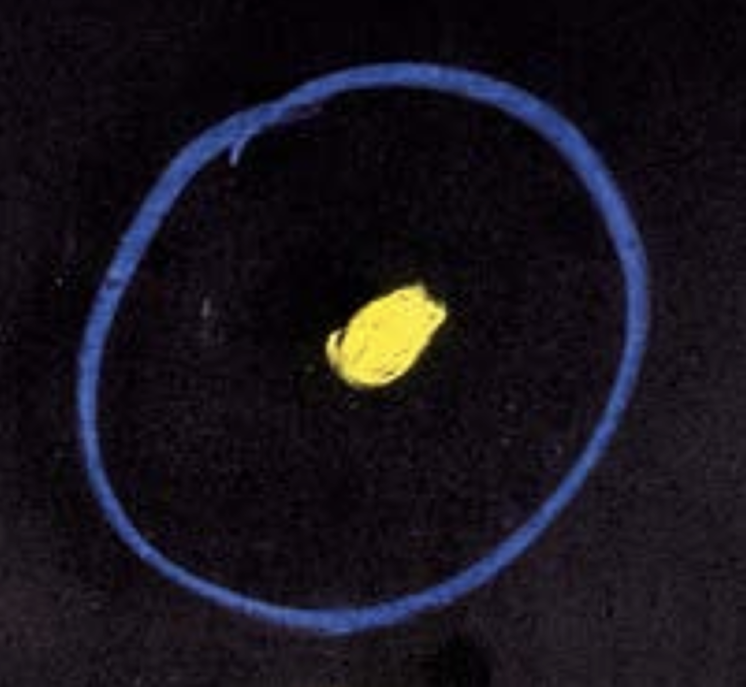
Blackboard 14, middle (detail): ‹In me is God,› evenings/ head man
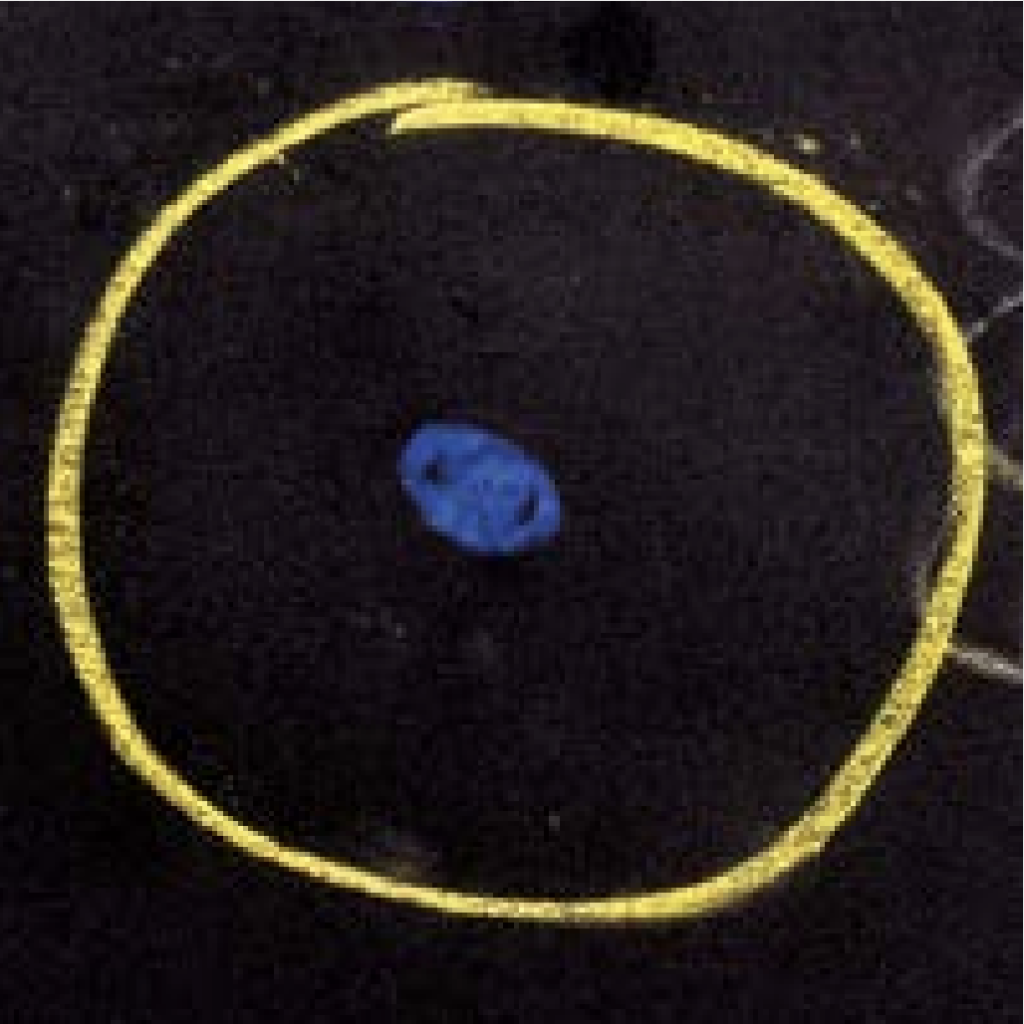
Blackboard 14, middle (detail): ‹I am in God,› mornings/ metabolic-limb man
9. Synthetic and analytic processes in shaping the overall form
Following on from this, Rudolf Steiner indicates how this manifests itself in morphological metamorphoses. In this first lecture, he had already indicated the special way in which the head system works to shape the body: in the head, all is brought together; it is a synthesizing, center-forming effect. This causes a breaking-down process. In contrast, in the metabolic-limb man, all is kept apart and separated; it is a disarticulating, analytic effect on the shaping of the overall form. The plurality and the specific peculiarities of the internal organs are formed. The internal dynamics of morphology are determined by the specific organization of all four members of the human being, the upper and lower man.
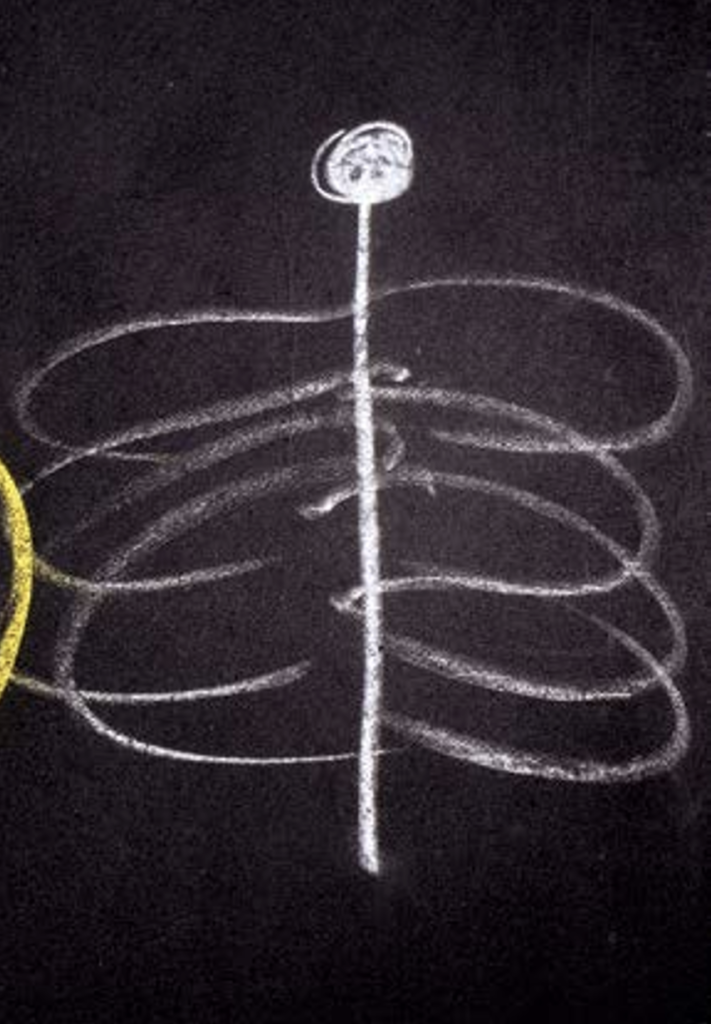
Blackboard 14, right (detail)
«But when the point [blue point/Blackboard 14 middle, top] asserts itself in the body, then it becomes the spinal cord.» [In the stenogram, «blue» is inserted here in long hand.] When the blue point manifests itself in bodily form, it works centrifugally or analytically, articulating and separating. When the analytic formative principle of the metabolic-limb man comes into play in the spinal cord, this results in the nerve fiber articulation of the spinal cord down to the cauda equina, the bundle of nerve fibers at the lower end of the spinal cord. If, on the other hand, the synthetic formative principle of the head man comes into play in the spinal cord, a center forms in the spinal cord, the spherical, contracted brain stem, as Rudolf Steiner explains below. Rudolf Steiner depicted these principles of action with white chalk on the far right of Blackboard 14: the spinal cord as a vertical line, presumably with the nerve pathways branching off from it—ending at the top with a sphere representing the brain stem. «When the point here [yellow point, middle/top] enters in, it becomes what it is to be in the head organization, namely the onset of the spinal cord.»[Rudolf Steiner ended the vertical line on the far right in white with a spherical shape, indicating the spherical bulge of the spinal cord in the area of the brain stem. Compare also the drawing on p. 248.]
Conclusions
By practicing this meditation, which moves between polarities, we more and more form and shape a third, middle, and mediating force: this is the builder and shaper of this very back-and-forth movement itself, who becomes ever more and more conscious through our practice. This middle force can place itself in an ever more conscious and thus more freely shaped relationship to these polarities. This third mediating force thus forms an ever moving middle between the polarities.
Translation: Joshua Kelberman (Note: All quotes from the Course on Education for Special Needs have been translated by Joshua Kelberman.)
Footnotes:
(1) This and following illustrations: Rudolf Steiner Archive, Dornach.
(2) For alternatives to the color coding in Tables 1 and 2, cf. Michael Domeyer, «Zum besseren Verständnis der Tafelzeichnung im Heilpädagogischen Kurs» [For a better understanding of the blackboard drawings in the curative education course], Seelenpflege in Heilpädagogik und Sozialtherapie [Soul care in curative education and social therapy], no. 1 (2002): 17–23; and Wilhelm Uhlenhoff, «Anders gesehen» [Seen differently], Seelenpflege in Heilpädagogik und Sozialtherapie, no. 3 (2002): 70–72.
(3) All quotations and page references refer to the German edition, unless otherwise indicated; see Rudolf Steiner, Heilpädagogischer Kurs [Curative education course], GA 317, 10th edn. (Basel: Rudolf Steiner Verlag, 2025). If words marked with square brackets appear in the quotations, these brackets have been omitted here for the sake of clarity; cf. Rudolf Steiner, Education for Special Needs: The Curative Education Course,CW 317 (Forest Row, East Sussex: Rudolf Steiner Press, 2014).
(4) These sentences could also be a transcription of a text by another author. Future research will hopefully clarify this.
(5) Mabel Collins (1851–1927), Light on the Path (London: Reeves & Turner, 1885). The second note from 1906 has already been published in: Rudolf Steiner, From the History and Contents of the First Section of the Esoteric School: Letters, Documents, and Lectures: 1904–1914, CW 264 (Great Barrington, MA: SteinerBooks, 2010), 153 (January 19).
(6) Ibid., CW 264, pp. 136–138.
(7) Eric Arlin, «Kreis und Punkt» [Circle and point], Seelenpflege in Heilpädagogik und Sozialtherapie [Soul care in curative education and social therapy], no. 3 (1983): 73–77; Peter Selg, Die Punkt-Umkreis-Meditation des Heilpädagogischen Kurses [The point–circumference meditation of the Course on Education for Special Needs] (Arlesheim, Switzerland, 2013); Walter Holtzapfel, «Punkt und Kreis im Heilpädagogischen Kurs Rudolf Steiners» [Point and circle in Rudolf Steiner’s Course on Education for Special Needs], in Walter Holtzapfel and Jörgen Smit, Die Heilkraft der Mitte [The healing power of the center] (Dornach, Switzerland, 1992), 11–27; Hans Müller-Wiedemann, «Punkt und Umkreis. Zur meditativen Erkenntnis des Zusammenhangs von Erkennen und Handeln im Heilpädagogischen Kurs Rudolf Steiners» [Point and circumference: On meditative insight into the connection between knowledge and action in Rudolf Steiner’s Course on Education for Special Needs], in Rüdiger Grimm, ed., Menschenbild und Menschenbildung . Aufsätze und Vorträge zur Heilpädagogik, Menschenkunde und zum sozialen Leben [Human image and human self-development: Essays and lectures on curative education, anthropology, and social life] (Stuttgart, 1994), 109–123; Bernhard Schmalenbach, ed., «Punkt und Kreis. Annäherungen an das Wesen des Menschen» [Point and circle: Approaches to the essence of the human being], Seelenpflege in Heilpädagogik und Sozialtherapie, no. 1 (2001): 2–26, including contributions by Hellmut Klimm, Karl König, and others.
(8) Further quotations are from pp. 172–173 (GA 317), unless otherwise noted.
(9) For more on sleeping and waking consciousness, see, e.g., the esoteric lesson of April 15, 1909, in Rudolf Steiner, Esoteric Les-sons 1904–1909: From the Esoteric School 1, CW 266/1 (Great Barrington, MA: SteinerBooks, 2007), 402f.