

Author: Dr. Wolfgang Rissmann Publisher: Salumed (2025) [only available in German]
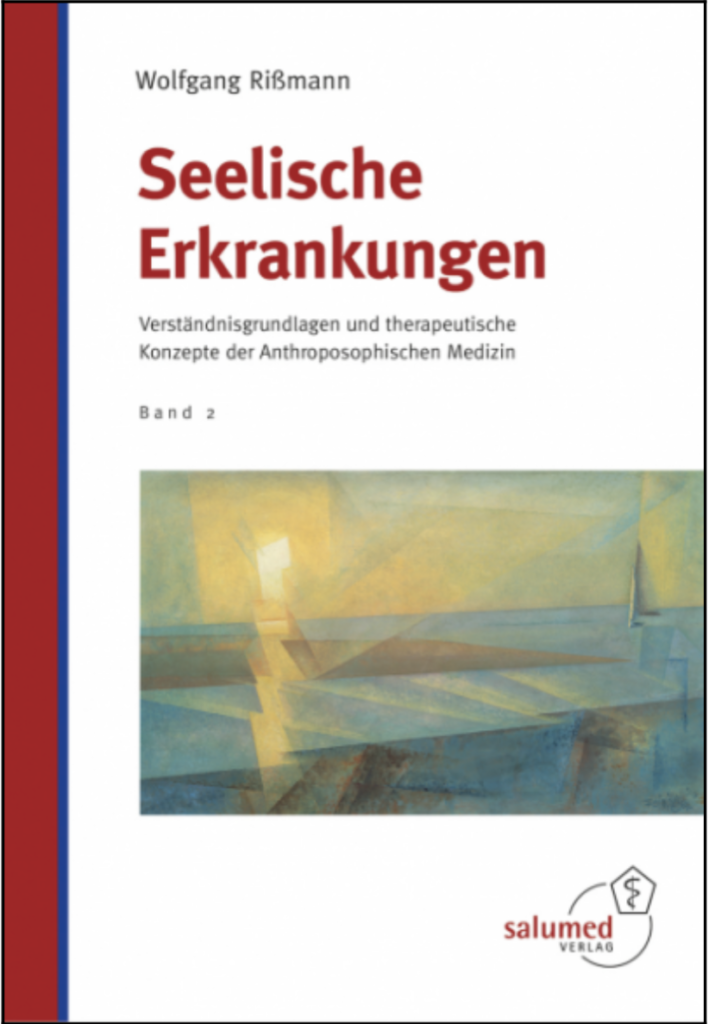
Dr. Wolfgang Rissmann has produced a monumental work. As stated clearly and comprehensively in the title, the book addresses a range of psychological, that is, soul-related, disorders. The author brings decades of professional experience in the practical treatment of patients with mental illness, gained through his senior position at the Friedrich Husemann Clinic in Buchenbach.
The book initially follows the nomenclature of the internationally recognized classification of psychiatric disorders, ICD 10. Readers learn all the essential information about the symptoms, progression, and treatment of individual psychological illnesses. From this perspective, it is an important and comprehensive reference work—helpful for anyone working in the sphere of social health.
But that is only one of its many aspects. It does not remain with only the «view from the outside,» though this is done in a very nuanced and in-depth way. But the book continuously seeks to further understand the perspective of those affected: What does an ill person experience and feel? In a letter dated July 12, 1915 to the editor of a Journal for the Care of the Disabled, Rudolf Steiner wrote, «One can hardly have a soulful relationship with anyone, if they cannot put themselves in the other person’s shoes.» (1) This is indeed the vocation of the practicing physician: the need to empathize, pointing toward a further empathy guided by knowledge as the foundation of medical practice. The many descriptions of individual medical histories in the text are a clear illustration of this.
Rissmann substantiates this ethical aspect early on in the work. In a chapter on «Aspects of the history of psychiatry,» he quotes Baron Ernst von Feuchtersleben’s work The Dietetics of the Soul: «[I] have attempted to bring the power of the human spirit over the body into practical clarity.» (2) This sets the tone for Rissmann’s presentation: the core of every human being is invulnerable to illness. This must be taken into consideration both in thought and in therapy. Thus, one section is devoted to the «lost art of healing.» Methods for genuine healing, grounded in an understanding of the disease process down to its most fundamental level, are a core concern of this work.
Although the book does not address certain specifics—such as how psychological illness manifests in children and adolescents, or how these conditions should be approached within curative education and social therapy—it nonetheless deserves a place on the shelves of every relevant library: in these kinds of institutions, in social work settings, and wherever therapeutic support of any kind is provided. The book is rendered essential by its comprehensive treatment of R. Steiner’s anthropology of medical pathologies across the full spectrum of psychological disorders, together with its detailed descriptions of the forms these disorders take.
What further distinguishes these two volumes is their accessibility, even for medical lay readers; the clear derivation of anthropological aspects from first principles; the avoidance of unnecessary foreign terms; and a thoughtful presentation and structure that make the reader feel understood and engaged.
Translation: Joshua Kelberman
Footnotes: (1) Rudolf Steiner to Willy Schlüter, July 12, 1915, in Rudolf Steiner, Briefe II, GA 30 (Dornach: Rudolf Steiner Verlag, 1987), letter 630. (2) Ernst, Freiherr von Feuchtersleben, The Dietetics of the Soul (London: John Churchill, 1852); first published inGerman, 1838