

Editors: Jan Göschel and Rüdiger Grimm
Publisher: Temple Lodge*
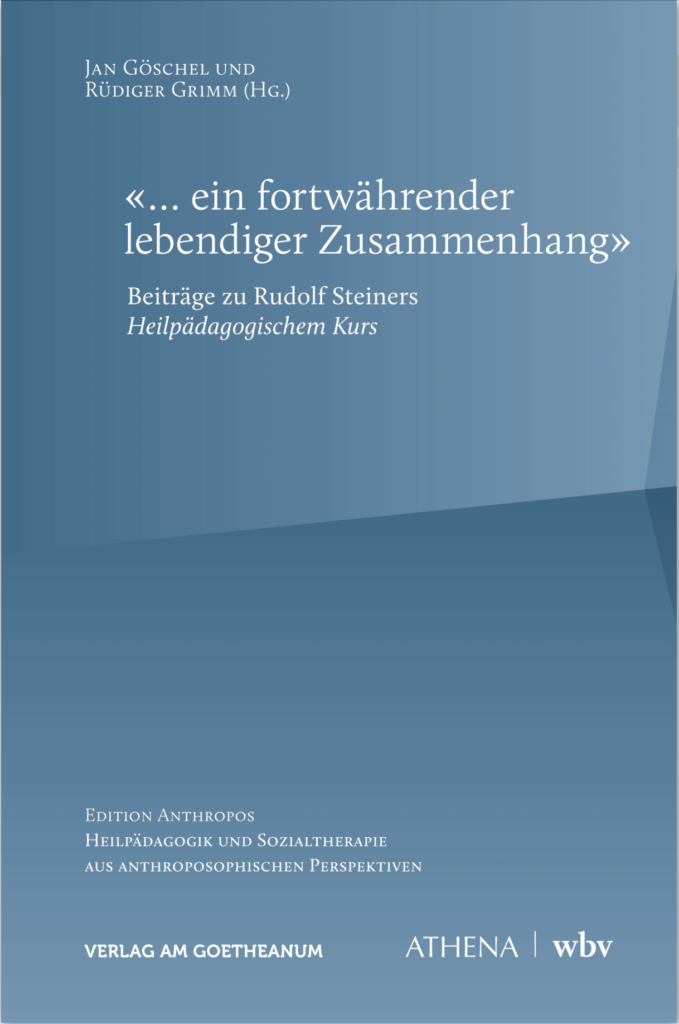
The Curative Education Course, the foundation and origin of anthroposophically oriented curative education and social therapy, was held by Rudolf Steiner at the Goetheanum in 1924 for a small circle of personally invited participants (twelve attendees are referred to, most known to us by name). The course consists of twelve lectures with different emphases. In addition to fundamental anthropological information, the central focus is on presentations of specific children with disabilities. Some of these children, patients of Dr. Ita Wegman, she personally introduced, while others were presented in case studies.
An annotated new edition of the Curative Education Course has been compiled and published, along with a companion collection of writings by authors from various professions including, curative education, psychology, and teaching. Many of the contributions were also written by physicians, which makes sense considering that curative education and social therapy were under the umbrella of the Goetheanum’s Medical Section for decades. Nevertheless, the contributions contain a diversity of perspectives and opinions, which alone make the book worth reading. The book is also internally coherent–all of its content relates to the Curative Education Course.
Beginning with contributions on foundational topics, the companion collection continues with the Curative Education Course's understanding of the human being. Then, it follows the children presented in the Course from their life situations at the time and on through their further biographies, to the extent that these are known. The fourth section follows the structure of the Curative Education Course and discusses inner development for curative educators. The book concludes with perspectives on the spiritual development of curative education.
If we follow the throughline of the individual contributions, three main elements become apparent. The first has to do with the relationship between the content of the Curative Education Course and more recent specialist knowledge, as discussed by Bernd Kalwitz, who offers a knowledgeable and differentiated picture. The second element is a striving for completeness. This book seeks to address and reflect on all of the important subjects touched on in the Curative Education Course. One example of this is Alan Thewless’s treatise on astrology. The third element is focused on the essence of the Course. It asks: What was established in the Course that continues to be essential and consistently valid, and that is still relevant and effective in anthroposophically oriented curative education and social therapy establishments and services today? Andreas Fischer's contribution on qualities, attitudes, ethos, and artistic understanding of tasks in anthroposophic curative education and social therapy may serve as an example here. Apart from the focus of the topics and the underlying interest in furthering knowledge, a distinction can be made in the contributions. Their approaches vary from analytical and historic-critical to intuitive, narrative, and meditative, always corresponding to the specific topic and the broader underlying question.
Toward the end of the book, Wolf-Ulrich Klünker presents a context of spiritual science, beginning with Aristotelian philosophy and ending with a suggestion for how to approach the Curative Education Course that seems worth considering: «In evaluating such interrelationships [as presented in the Curative Education Course], it seems important not simply to ask, ‹Is this true?› but rather to understand a presentation like this as broadening our perspective and as increasing our sensitivity in certain areas of perception.»
I wish both the Curative Education Course and this companion collection a large number of readers with this attitude.
Translated from German by Tascha Babitch.
*Note: The English translation of the new edition of the ‹Curative Education Course› (Rudolf Steiner Press) and the original companion collection (Temple Lodge) will be available in English in 2026.