

Author: Tim Jackson
Publisher: Polity Press (2025)
Tim Jackson is an economist and playwright. He became well-known as a leading theorist of postgrowth economics with the publication of Prosperity without Growth: Foundations for the Economy of Tomorrow (2017). That book, which started out as a report for the UK government in the aftermath of the 2008 global economic crisis and was quickly ignored and abandoned by those who commissioned it, resonated deeply when it was subsequently published in book form. This classic of post-growth economic theory was revised and republished in 2017, laying the groundwork for Post Growth: Life After Capitalism (2021). Both earlier books are recognizably works of an economist, with no shortage of technical discussion, though they are written in a clear and lucid style, suitable for non-economists who are prepared to do a bit of work to follow Jackson into the territory of deep transformation as the world confronts the limits of the growth dependent economic paradigm that has driven the modern age for the last 500 years or so.
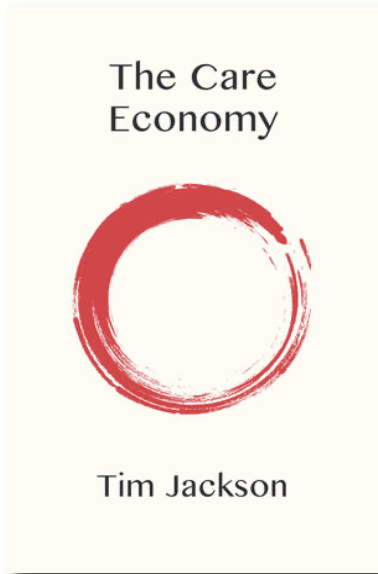
The Care Economy (2025) is a different type of book altogether. Though grounded in economic thought and building on his earlier two works, it shifts the conversation onto a much more imaginative plane. Jackson, the playwright, enters the conversation about the economic paradigm of the future.
Jackson picks up on his earlier diagnosis of what the limits of growth look like, how we got there, and why we need to extract ourselves from our dependency on continuously accelerating GDP growth and the ever-expanding material and energy throughput required to achieve it. In brief: we are locked into an economic model, through the way that our finance system works, that served to stimulate innovation and development, lifted many out of poverty, unlocked incredible technological resources and propelled global civilization from the pre-modern age into the late modern world of today. Now, we find ourselves here, materially wealthy, as never before, but unable to get back out of acceleration mode, as we have moved beyond the limits of what the well-being of human beings, society, and the earth can support. Beyond these limits, economic growth no longer enhances human well-being, but turns into the primary cause for its deterioration, while at the same time threatening to destroy the ecosphere that makes human life possible in the first place.
At the center of Jackson’s economic diagnosis stands a phenomenon known as Baumol’s cost disease. Having wound his way through themes as apparently divergent as the Greco-Roman goddess of Care, a redefinition of prosperity as health, the conditions for the maintenance of health, the current opioid crisis as a twisted counter-image of health care, the experience of cold water swimming, the nature of self-regulation in living beings, the intrinsic restorative force of life, the reasons why the economy (as it currently functions) constantly acts against the restorative principle, the origins of the British NHS, Gertrude Stein and Florence Nightingale, the nursing model of disease as a restorative process, the modern rejection of ‹feminine› care in favor of ‹masculine› interventionist approaches in medicine, the economy, technology and life in general, and the pathogenic consequences of all of this, Jackson meets William Baumol (1922-2017) in the climactic chapter of his book. This meeting takes place as a conversation on the night side of reality, in the space of imagination, during what is described as a kind of spiritual experience at Stonehenge (with Hannah Arendt as another interlocutor, to prepare Jackson for the experience).
Baumol explains to Jackson why it is that, in a growth-dependent economy, even as societies become materially ever wealthier, the very activities that directly support well-being, health, and quality of life – culture, creativity, crafts and care – are progressively stripped of resources and suffocated. As the material goods produced in the productive real economy get ever cheaper, as a result of innovation and efficiency, those activities that do not support efficiency without losing their essential quality – i.e., everything that depends crucially on the time and attention of a human being – becomes more expensive in relative terms. As opportunities for real material economic growth eventually become scarcer, a growth-dependent economy takes more and more of its resources away from these ‹slow› sector activities and allocate them to the material economy, even to materially productive activities, but ones that are adverse to well-being (war and weapons production, addictive substances and products, ecologically and socially extractive and destructive processes), to desperately keep GDP growth going and prevent its own collapse. Thus, while in the early phases of development, the greater material wealth achieved through growth enabled culture, crafts, and care, the systemic dependency on further growth past this critical inflection point turns this mechanism in against itself.
Care directly brings forth human and planetary well-being – the true purpose of economic activity – but it is intrinsically inimical to the efficiency and acceleration needed for growth. Late modern economies stuck in growth dependency progressively withdraw funding from culture, art, education, health care, social care and similar activities, while engineering artificial ways of maintaining growth, such as war and military production, addictive technologies, junk food and junk medicine, that do not contribute to health, well-being and human flourishing, because failure to grow in the current system leads to economic collapse, and the consequences of that seem to dire to even contemplate – even as the growth addiction destroys human beings, society, and the earth.
The way out of this systemic addiction to growth, according to Jackson, is to place care firmly at the center of the economy. The Care Economy, in the sense of his book, is not (just) the economy of the care sector: it is the economic paradigm of the future, post-growth-dependency. An economy built around care uses metrics that measure human, social, and ecological flourishing, rather than material throughput, as measures of its success. It works with ways of financing its activities that don’t perpetuate growth dependency but are oriented towards sustainability and regeneration. It treats care, education, and creativity as the true investments in the future of society, rather than a burden to growth. Having extracted itself from the pressure to stabilize itself through growth, even at the expense of well-being, it leverages efficiency and innovation in the material productive economy to allocate more resources to culture, crafts and care. To do that, it allows activities and sectors to grow or shrink as needed to support human and planetary health and well-being.
To accomplish this, critically, and in ways that echo themes from Rudolf Steiner’s unusual lecture on ‹The Royal Art in a New Form› (January 2, 1906; in GA 93), Jackson – following a tradition of feminist thinkers from Daphne du Maurier and Gertrude Stein to Riane Eisler – points out that a deep cultural shift is needed. The challenge is to overcome the one-sided ‹masculine› (patriarchal) gesture that has driven the developments of the last 500 years, and to re-integrate the ‹feminine› principle of care, maintenance, restoration of life, and healing into our approach to creating new economic and social paradigms in accordance with the conditions for life, flourishing, and well-being. Such new economic and social thinking – here, also, Jackson resonates with Steiner – can only be accomplished by engaging the imagination, not by analytical thinking alone. The Care Economy is Jackson’s contribution, as an economist playwright, to that challenge of a new social art, grounded in care.
Literature:
Jackson, T. (2017). Prosperity without Growth: Foundations for the Economy of Tomorrow. London: Routledge.
Jackson, T. (2021). Post Growth: Life after Capitalism. Cambridge: Polity.
Steiner, R. (2014) (GA 93). Die Tempellegende und die Goldene Legende als symbolischer Ausdruck vergangener und zukünftiger Entwickelungsgeheimnisse des Menschen. 4. Aufl. Basel: Rudolf Steiner Verlag.