

Author: Rüdiger Grimm
Publisher: Kohlhammer (2025) [Only available in German]
What prompted this publication?
Nearly ten years ago, on December 23, 2016, the Federal Participation Act [Bundesteilhabegesetz, BTHG] was enacted in Germany and subsequently implemented in four phases. The goal was to strengthen the self-determined participation of people with disabilities and to further develop integration assistance into a modern right to participation guided by the UN Convention on the Rights of Persons with Disabilities (UN CRPD). With the second phase of reform (effective January 1, 2018), the law governing rehabilitation and participation was fundamentally restructured. Social Code IX [Sozialgesetzbuch, SGB] was completely revised, and, among other things, a cross-agency participation plan procedure was introduced. With the third and most far-reaching phase of the reform (effective January 1, 2020), integration assistance was separated from social assistance law (SGB XII) and fully transferred to SGB IX as a benefit-based system. Among other things, this further strengthened a person-centered approach and reduced reliance on institutions.
Thus, Section 121 of SGB IX stipulates that the provider of integration assistance must develop a comprehensive plan to determine the need for services. This comprehensive plan serves to manage, monitor the effectiveness of, and document the participation process. The beneficiary—that is, the person receiving assistance—must be involved in the overall planning process, but not the service provider—that is, the facility or service that provides the participation-related services.
The complexity, demands, and requirements of the overall planning process have overwhelmed service providers—and continue to do so today. The monocausal conceptions underlying the required impact assessment of funded participation services do not do justice to the complex and interactive process of accompanying and supporting people who need assistance. In 2019, therefore, a project was initiated by the Anthropoi Association [Bundesverband] and supported by the Software AG Foundation. One of its objectives was to empower people who require assistance in asserting their right to self-advocacy vis-à-vis service providers, while at the same time supporting their autonomy within the service providers' offerings and organizations. One outcome of this project was the reference book, developed and authored by Rüdiger Grimm, Participatory dialogue: Supporting self-determined living for people with assistance needs [German: Teilhabe-Dialog: Selbstbestimmte Lebensführung von Menschen mit Assistenzbedarf unterstützen].
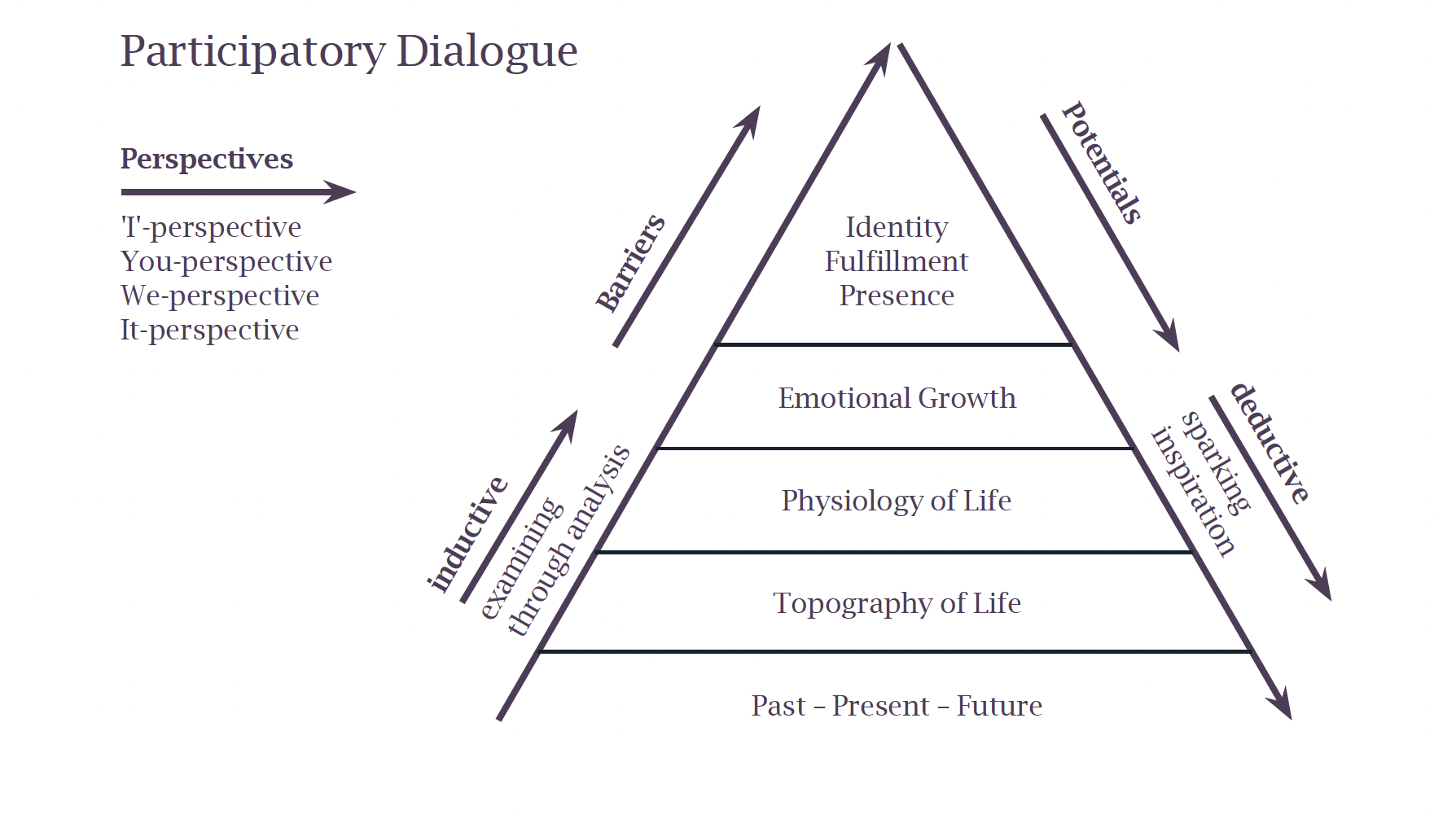
Image: Grimm, R. Teilhabe-Dialog [Participatory Dialogue]. Kohlhammer. 2025 (Translated by the editors)
What is the goal of participatory dialogue?
Participatory dialogue aims to serve as a comprehensive professional framework for shaping a social culture that enables people who require assistance to lead self-determined lives and participate in society. The participatory dialogue framework thus seeks to contribute to successful individual lives, while also supporting communities, institutions, and services dedicated to this purpose and providing guidance on social relationships—particularly regarding the interaction between beneficiaries, funding agencies, and service providers.
Following the introduction, the book outlines the theoretical framework and then describes participatory dialogue as a process, thereby making the structural aspects more concrete and tangible as a whole. A chapter on theoretical foundations and key questions is then provided, in which the aspects and elements of the theoretical framework are examined in greater depth. This is where Rüdiger Grimm takes a critical look at the development and implementation of the Federal Participation Act in Germany and addresses the so-called «social relationships triangle» between the beneficiary, the funding agency, and the service provider. As mandated, these Germany-specific legal frameworks are repeatedly referenced in discussions of other professional foundations. At the same time, however, these topics are handled in such a general and fundamental manner that they can also benefit international readers.
First, he covers the historical development leading up to the UN Convention on the Rights of Persons with Disabilities (UN CRPD), as well as its drafting and implementation. This is followed by a brief introduction to the ICF (International Classification of Functioning, Disability, and Health). Finally, the key concepts of ‹self-determination› and ‹participation,› which are central to the framework, are clarified and discussed in depth. The forms of support included in the framework—«education, counseling, and support»—are also covered in detail.
What are the essential steps in the participatory dialogue?
The temporal structure of the participatory dialogue is based on the idea of gradually bringing one's individuality and one's environment (that is, in a sense, the social structure of the human being as a point and circle) into consciousness, thereby leading to new, self-determined approaches to action and opportunities for participation. I find the pyramidal structuring of the essential elements of the social form chosen by Rüdiger Grimm (see illustration) to be an ingenious approach. I think he coherently translates the different members of the human being (which are of essential importance for both therapeutic and educational perspectives) onto the social level in such a way that it makes possible a holistic and inclusive perspective tailored to the demands of the situation.
Participatory dialogue begins in the «topography of life» with an observation and assessment of the immediate living, work, and leisure environment of the person who stands in the center: What is there that is relevant to this person, and where is it? And how should this environment be configured?
In the next step—the «physiology of life»—the dynamic equilibrium among these areas themselves and between the individual and each of these areas is examined in greater detail. How do the individual's capabilities, forces, and constitution relate to the demands and offerings presented by the environment? How does the person experience themselves bodily, in terms of their will, their feelings, and their thoughts? It is at this point that people usually first become painfully aware of their present barriers and limitations. The same applies to the third field, «relationships, motives, and configuration,» which deals with social connections, roles, and interaction, as well as the motives and goals the person prioritizes, the topics and interests that are important to them, and how all of this is expressed and organized.
In the fourth field—the question of «fulfillment, presence, and identity»—we look back at the preceding three fields from the «perspective of the ‹I›.» Based on the desired interpretation, one can assess what should be retained, abandoned, changed, or newly developed. In this way, moving backward, step by step, from the third section to the second and then to the first, new potentials and possibilities can be discovered, formulated, and developed. The process begins (inductively) with the perception of the individual elements of the environment and, in the second part, is guided (deductively) from the conscious individuality toward the (re)configuration of the environment. To ensure that the participatory dialogue can unfold its full potential, the individual steps and their sequence should be followed as closely as possible. The «‹I›-perspective» of the individual at the center (with advocacy support, if necessary) serves as the guiding principle. At the same time, the dialogue requires a questioning and seeking «You-perspective,» as well as a (social) «We-perspective,» and a (purely factual) «It-perspective» of the individual's surroundings.
What is the basis for participatory dialogue, and what opportunities for further development does it offer?
Participatory dialogue is based on the anthropological, professional, and ethical foundations of anthroposophical supportive education and the promotion of inclusive social development. When applying the participatory dialogue, the tools and methods developed in practice can be utilized.
The section «theoretical foundations and research questions» points to the roots of this approach in the «children's conference» and related scholarly publications. (1)
As examples of social diagnostic methods and tools that can be integrated into the participatory dialogue conceptual framework, well-known approaches such as Personal Future Planning are cited. With regard to anthroposophically inspired methods (again, this list is not exhaustive), reference is made to the Biographical Timeline Process (BTP) by Beth Barol; Intuitive-Rational Case Hermeneutics by Maximilian Buchka; and Paths of Life: Biographical Work and Biographical Coaching for People with Disabilities by Hein Kistner.
Reinhard Sprang developed and tested the tool «How Do I Find My Future» as part of the Anthropoi Association project mentioned above. The aim is to help identify the intentions of people with severe cognitive and communicative impairments. It is based on the premise that professionals understand behavior as a kind of speech and that they find highly personal ways to engage in dialogue. The Anthropoi Association provides introductory information, a guide, and case studies via this link: https://public.anthropoi.de/s/jGNtAiXpJdC4BH6
A Call for an Informed Discussion
At this point, it's very important to me to make a disclosure regarding transparency. As the then-executive director of Anthropoi Association, I helped initiate and support the development of participatory dialogue in a spirit of intentional and friendly collaboration with the author, Rüdiger Grimm. I co-edited the text and wrote the foreword. Ideally, no one should review a work to which they have contributed. An unbiased perception, reflection, and evaluation, unencumbered by the original intentions behind its creation, is essential for a scholarly contribution. Without this, it remains a work that, at best, is accepted but lacks the grounding of scholarly discourse, which is what makes its organic unfolding, refinement, and further development possible. That is why I would like to warmly invite you to critically examine Participatory Dialogue, test it in practice, and provide feedback from various perspectives—in this way, we enter into a true scholarly discourse. A brief, quite favorable review has already been published in the journal Punkt und Kreis, no. 82 from Christmas 2025. (2) In his concluding remarks, reviewer Frank Ilge emphasizes that the work is not only a practice-oriented workbook but also a valuable contribution to the scholarly discourse on inclusion and self-determination. I hope this work will generate a strong professional, scholarly, and discursive by response!
What might be some starting points for a discussion?
It should be primarily up to the readers who were not involved in the creation of this publication to determine which content and statements in it provoke thought, spark disagreement, or give rise to alternative perspectives and where there is a need for correction, discussion, or further elaboration.
Above all, I see a need to further develop the participatory dialogue process in practice and to operationalize it more effectively. Support for practical application and interfaces with the tools of biographical work and participation planning, as well as with the overall planning process, should also be developed. Furthermore, we are still in need of a plain-language version (which was actually supposed to be created as part of the project). An attempt to derive such a version purely from the text was not successful. This requires conceptual work (prioritization and selection of content, etc.) and, crucially, the active participation of people who need assistance.
The legal foundations and framework conditions discussed in this publication must be updated and adapted as needed. Unfortunately, restrictions on services are currently being prepared and enacted in Germany, which jeopardize the rights to participation that have been achieved or are still being pursued.
This makes it all the more important to actively engage in a participatory dialogue that is designed to safeguard and enhance the rights and quality of life of people who need assistance in their daily lives.
Translation from German: Joshua Kelberman
Notes:
(1) Comprehensively covered in Göschel, J. (2012). Der biografische Mythos als pädagogisches Leitbild: Transdisziplinäre Förderplanung auf Grundlage der Kinderkonferenz in der anthroposophischen Heilpädagogik [The biographical myth as pedagogical model: Transdisciplinary support planning based on the children's conference in anthroposophical supportive education]. Edition Anthropos: Heilpädagogik und Sozialtherapie aus anthroposophischen Perspektiven 1 [Supportive education and social therapy from an anthroposophical perspective], series ed. Rüdiger Grimm (Dornach and Oberhausen: Verlag am Goetheanum and Athena Verlag, 2012).
(2) Ilge, F. (2025). «Ein neues Verständnis von Teilhabe ist notwendig» [A new understanding of participation is needed], Punkt und Kreis [Point and circle] 82 (Christmas 2025): 22.
Previous articles on this topic in Seelenpflege in Heilpädagogik und Sozialtherapie in German:
Fankhauser, B., «Aus der Praxis der Biografiearbeit» [From the practice of biographical work] (2012–1): 41–44.
Göschel, J., «Der ‹biografische Mythos» [The «biographical myth»] (2012-1): 6–13.
Lindmeier, Ch., «Biografiearbeit mit Menschen mit geistiger Behinderung im Alter» [Biographical work with older adults with intellectual disabilities] (2012-1): 23–40.
Barol, B., «Aus der Biografie lernen. Eine Einführung in den ‹Biografical Timeline Process›» [Learning from biography: An Introduction to the Biographical Timeline Process] (2013-3): 6–20.
Kistner, H., «Das eigene Leben studieren—vom Leben lernen. Biografiearbeit mit Menschen mit schweren Behinderungen im Umfeld Sterben, Tod und Trauer» [Exploring one's own life—Learning from life. Biographical work with people with severe disabilities in the context of dying, death, and grief] (2013-3): 37–53.
Ewertowski, J., «Das biografische Wesen des Menschen im Raum der Zeit, Zur Methode der individuellen Lebensgeschichte» [The biographical nature of human beings in the realm of time: On the method of individual life history] (2014-3): 6–12.
