

Author: Annette Pichler
Publisher: Info3 Verlag [Currently only available in German]
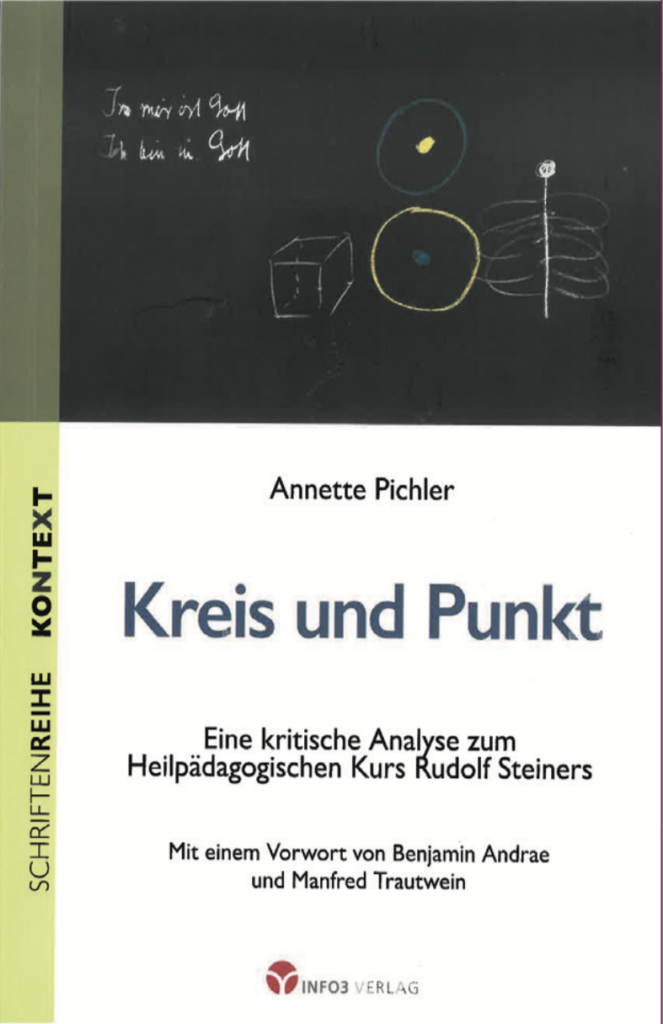
This book explores Rudolf Steiner’s Curative Education Course from a place of experience and well-founded knowledge of the subject. It is written with a sometimes critical, other times self-reflective eye. It is a rare, courageous, and highly topical addition to the genre known as anthroposophic secondary literature. In the spirit of the current trend toward inclusion in the social professions, the author points to the dilemma that arises because it is now considered problematic to discuss people and question their actions if those people are not present, but the people described in this Steiner course have long since died. She questions the path in it from diagnosis to therapy from today’s perspective – a path that, because of its partly spiritual orientation, raises questions and considerations that were not asked in 1924 and in Rudolf Steiner’s presence. On a topic that will be further discussed, she writes that she cannot «leave this situation unaddressed, because in my opinion anthroposophy should not simply be handed down unquestioned, but must enter into active dialogue with current debates and paradigms in order to be relevant and meaningful and to develop its full potential».
A hundred years after Rudolf Steiner’s Curative Education Course, there are over 750 anthroposophy-based and -inspired establishments for curative education and inclusive social development in sixty countries – an expansion worthy of a separate article. The twelve lectures in the Course have sparked an impulse that has become the foundation of daily life for many thousands of people with disabilities and a temporary or lifelong vocation for thousands of others. Even before discussing this book, we might therefore ask to what extent the contents of this lecture cycle are consciously cultivated and implemented in the various establishments worldwide. And the reality is that this is often done only to a limited and modest degree – the result of a multi-faceted situation. Anthroposophic professional training courses in this field are forced to make extensive modifications to their curricula in order to obtain and maintain official operating licenses and to comply with official regulations. This necessitates reducing the scope of relevant anthroposophic content. The Curative Education Course is «hardcore» anthroposophy, and there is hardly even time to lay the foundations for deciphering it. And those who treat the Course as a kind of ‹deus ex machina› often lack the ability to contextualize and confront its content with the immense world of research and practical developments in this field over the last hundred years. Even at some curative education and social therapy training centers that strive to teach anthroposophic principles, this text is no longer required reading. As a result, engagement with its content is very often largely absent in these institutions.
A first attempt…
The Point-and-Periphery model and the meditation of the same name are at the center of this course. It is a minimalistic reduction of several central motifs in anthroposophy and its study of spiritual science and the anthroposophic understanding of human beings and the world; of incarnation, excarnation and reincarnation, of the human I and its layers, and of the material world and its paths to transcendence. The lecture cycle contains a synthesis of this motif, which Steiner discusses in numerous places in other forms and contexts. This book ventures to demystify this motif. As a result, this Steiner lecture cycle, which is often considered impractical today due to its partially esoteric nature, transforms from an enigmatic mystery to a source of professional inspiration – gaining both topical relevance and appeal. It is to Annette Pichler’s credit that she has attempted to use contemporary professional tools to approach an analysis of this cycle, to ask critical questions and to build a bridge for people who want to engage with this cornerstone of anthroposophic social work today, so that they can also enter into the spiritual dimensions of the text. In curative education and inclusive social work worldwide, we talk about «caring for the psyche [or soul]». Paradoxically, however, for decades too little attention has been paid in these circles to the continued development of psychological research and practice. Those familiar with the Course will recall Steiner’s disparaging comment, «Psychoanalysis is dilettantism squared» (Steiner 2024, p. 88). Pichler is a psychologist. Her approach to the content of the Course (and to her readers) is characterized by a conversational tone that almost transforms this text into a dialogue. She does not shy away from questioning the treatment methods described in it from today’s perspective – with questions to which, for decades, the answer has all too often been: «You still haven’t understood what Rudolf Steiner really meant by that – you need to take further steps in your spiritual development.» Psychological methods do not inherently contradict spiritual science and anthroposophy. This latter, however, if not understood on a deep level but only attempted to be implemented as a model, has an even greater potential of causing methodological errors and therefore damage – including in a karmic sense – to clients and professionals alike. Pichler moves freely within this charged space and demonstrates radical honesty and self-reflection – not only freely, but also in a way that liberates her readers: «In my opinion, therefore, it would be a serious mistake to assume that Steiner must always have grasped the complete truth due to an infallible ‹path of initiation›». In her attempt to analyze Steiner’s approach to relationships, diagnosis and therapy using a concrete example, she admits that she is «very aware that this attempt must necessarily remain imperfect and that my impression may also be wrong.»
In contrast to other lecture cycles, the Curative Education Course was not attended by hundreds of people, but only by 21 people – specialists and close colleagues of Steiner. For this reason, his approach was very pragmatic and concrete. Most of the content is directly related to the children that he presented, all of whom his audience either already knew or had become familiar with during the course, and to the phenomena the children exhibited to which he wanted to draw attention. This book is a first attempt not only to juxtapose universal approaches and concrete biographical situations, but also to critically examine concrete, specific recommendations by Steiner in the light of current standards, without fundamentally questioning meditative engagement with the Point-and-Periphery idea and its potential for stabilizing the life of the psyche/soul.
… that breaks new ground
Rather, Pichler describes her own experiences in her contemplative and meditative approach to the Point-and-Periphery motif:
«If I call up […] Steiner’s image of a metamorphosis of head and limbs beyond this current life, I am leaving behind this familiar realm of perception. A movement arises that goes far beyond what I am able to grasp with my present capacity for perception.»
Thus, her book also becomes an introduction to the Curative Education Course. And it indicates on the one hand that this Course represents an extension of Steiner’s study of the human being, and on the other hand that after close examination and individual analysis, when read in the way that Pichler suggests, Steiner’s initially personal and person-specific references do indeed have a universal, general human significance.
One focus of the book is the treatment of Willfried, a child with hydrocephalus, and Steiner’s relationship with his mother, Theodora Kunert, who entrusted him with her child. (1) Steiner observed that the mother had an «abnormal soul life» (Steiner 2024, p. 349), which resulted in the child remaining in a kind of embryonic existence even after birth. He recommended immediate weaning of the child, and later on even physical separation from the mother, as well as treatment in a darkened, secluded room without real relating, other than what was necessary for administering medical treatments. (2)
Pichler examines Steiner’s recommendations for the mother and child from the family systems perspective (not yet developed in Steiner’s time). She scrutinizes Steiner’s conversations with the mother, references the nursing codes of conduct, and focuses especially on the separation of mother and child. In doing so, she refers to the deep and extensive knowledge we now have regarding the psychological bond a newborn has with its mother and its significance for the child’s physical, emotional and intellectual development – which includes physical and psychological closeness in the period immediately following birth. The scope of this review does not allow us to go into more detail on the topic here.
It must be said, however, that though the author has unmistakable respect for Steiner’s authority, she does not hesitate to critically scrutinize questionable elements of the Course. In a publication that engages critically, analytically and on a very personal level with Steiner’s course, there is a tendency to find fault and criticize shortcomings. However, it is worth reading this book if we can follow the author’s train of thought and are able to perceive how she wrestles with her discoveries – and that where she is unable to reach conclusive results, she leaves questions open. In its last sub-chapter, Die Aufarbeitung von Leid und Gewalt und ein neues Selbstverständnis [Working through suffering and violence and a new self-awareness], the book ends on a fortissimo. The issues of physical, psychological and sexualized violence can arise, even in establishments that strive to be anthroposophic. Measures carried out on vulnerable persons by staff with no specialist training and with only a sketchy understanding of the anthroposophic view of the human being can have devastating consequences.
The therapeutic potential of a community can only unfold if there is a solid understanding of cause and effect in the therapeutic process. According to Pichler, the question of the extent to which the concept of community can be superseded by the trauma-informed concept of a safe place, and what that will actually look like, is a central one for the coming years. Therefore, this book also functions as a call—not only point-related, in terms of Rudolf Steiner’s Curative Education Course, but equally periphery-related in the daily life of establishments all over the world—to find a new approach that takes into account today’s knowledge of the field.
This book does not cover every element in the Curative Education Course and does not claim to do so. For example, medical measures undertaken in the case of the child, Willfried, are not discussed. Nevertheless, it is a ground-breaking book that outlines a contemporary approach to Rudolf Steiner’s works. As such, it sets out on a path that could bring this course back to the center of anthroposophic curative and inclusive education, and offers an honest, personal, and yet accessible and appealing way of engaging with its content. Pichler writes, «The point-and-periphery meditation connects meditators […] directly to the awareness of a dynamic reality between those physically present and their respective spiritual points of reference». Anyone who wishes to verify this will have to take up the practice themselves. This broadens the audience for this book beyond curative educators and social therapists to anyone with an interest in an innovative, grounded, personal and compelling approach to Rudolf Steiner’s work.
Translation from German: Tascha Babitch
Note: We would like to thank the magazine ‹dieDrei› for their kind permission to print this review.
Footnotes:
(1) Theodora Kunert later became known as a writer under the name Maria Josepha Krück von Poturzyn.
(2) I myself heard Lucia Grosse's account in the 1970s. She was a nurse and had to take care of the child in the Arlesheim clinic in silence, without words, without emotional attention and in a darkened room.
