

Author: Andreas Fischer
Publisher: Anthrosocial*
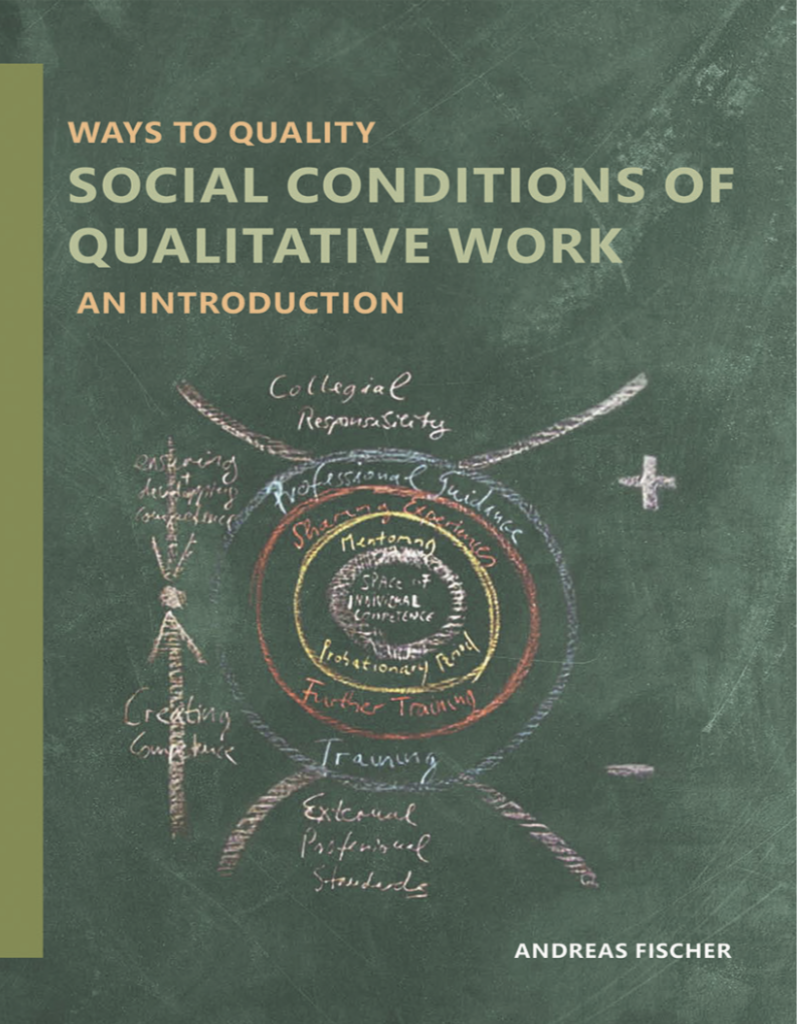
How to define quality in social work? What constitutes ‹good› social work and who is authorised to judge it? How, by whom, when and on the basis of what criteria is it possible to determine quality in social work?
The complexity of these questions quickly becomes apparent when you think back to your own school days. Looking back, many have a clear idea of which teachers supported them in their own development, which school events and elements really helped them to progress. How many of these aspects of ‹good schools› that we recognize in retrospect would have been mentioned in a quality survey or a school evaluation? Our own frame of reference and the resulting conclusions about ‹good schools› are highly subjective, situational and changeable over time. Even though we are aware of this to some extent, we are quick to offer appropriate advice, expectations and requirements when discussing ‹school and teaching quality› – whether for the sake of our own children or for the future of society in general. This brief thought experiment on ‹good schools› illustrates that when considering quality procedures in the field of social work, we are dealing with a multifaceted topic.
In his introduction to Ways to Quality, Fischer introduces the main features of this methodology. He differentiates the question of quality from the long-standing concept of quality assurance and presents the logic of social conditions as underpinning the methodology. This places the question of the social conditions for qualitative work before the question of any external characteristics or standards on the basis of which conclusions are drawn about qualitative work.
Ways to Quality is presented as a methodology that creates a suitable basis for quality development. To this end, the author places those affected by social work, the clients and the employees with a support mandate, at the centre of the consideration and assumes a development that is reciprocal, even conditional. An idea that is immediately apparent in ‹good school› example: For ‹Fritz and Mrs Meier›, different elements make up a good time at school than for ‹Fränzi and Mr Müller›. Mr Müller might not have been able to act like Mrs Meier, but for all four it is possible to determine which conditions, e.g. of trust, protection, freedom and ability, make ‹good school› possible and how the ‹service provision through relationships› between the parties involved must be embedded so that healthy development is possible for both sides.
The methodology of Ways to Quality comprises twelve fields that describe the various forces influencing qualitative work. The author succeeds convincingly in providing an overview of these twelve fields and, by juxtaposing the pairs of fields that are related to each other, he is able to highlight the connections and the underlying overall context in an understandable way. The simple language and practical examples – no wonder, even a ski camp is used here – help the reader engage with the subject.
The author has managed the balancing act between simplification and trivialisation in the spirit of field nine Individual Development: «Only those who are prepared to develop themselves can accompany other people in their development». This introduction is a stimulating, multi-layered and yet entertaining text for readers who are ready to develop themselves, and it will inspire them to take their first steps and delve deeper into the pathways towards quality.
Translation from German: Christina Schmalenbach
*Note: The brochure can be requested in English as a pdf from: stiftung@wegezurqualitaet.info
